TL;DR
- A React Native developer builds iOS and Android apps from a single JavaScript or TypeScript codebase.
- The role covers 6 daily tasks: component building, API integration, native module bridging, dual-platform testing, bug fixes, and store releases.
- React Native developers write Swift, Objective-C, Kotlin and Java when a feature needs camera, Bluetooth, biometrics or payment hardware access.
- The role excludes backend architecture, original UI design, native game engines and production DevOps.
- Core skills span React hooks, state management, Xcode configuration, Android Studio builds and code signing.
This guide walks through the daily workflow, the native code side almost nobody explains, the skills that separate a real React Native developer from a React web developer, and the tools that fill the working day.
What is a React Native developer?
A React Native developer is a mobile engineer who builds iOS and Android applications from a single JavaScript codebase using the React Native framework. One developer, one codebase, two shipped apps.
React Native arrived in 2015 and now sits among the most-used cross-platform frameworks worldwide. The appeal is arithmetic: two native teams cost roughly twice one React Native team, and feature parity across platforms stops being a scheduling problem.
How React Native works in plain terms
React Native renders genuine native interface components, not a website wrapped in an app shell. A <View> becomes a UIView on iPhone and a ViewGroup on Android.
The framework historically passed messages between JavaScript and native code across a bridge, and the New Architecture replaced that bridge with Fabric and TurboModules for direct synchronous communication. Hermes, the JavaScript engine built for React Native, handles execution on device.
How the role differs from a React web developer
A React Native developer ships to app stores, while a React web developer ships to a browser. Both write React components with hooks and state, so the mental model overlaps heavily.
The divergence is everything around the code: Xcode and Android Studio builds, provisioning profiles, simulator testing, and a review queue that gates every release. A React web developer deploys in minutes, and a React Native developer waits on App Store review.
What Does a React Native Developer Do Day to Day?
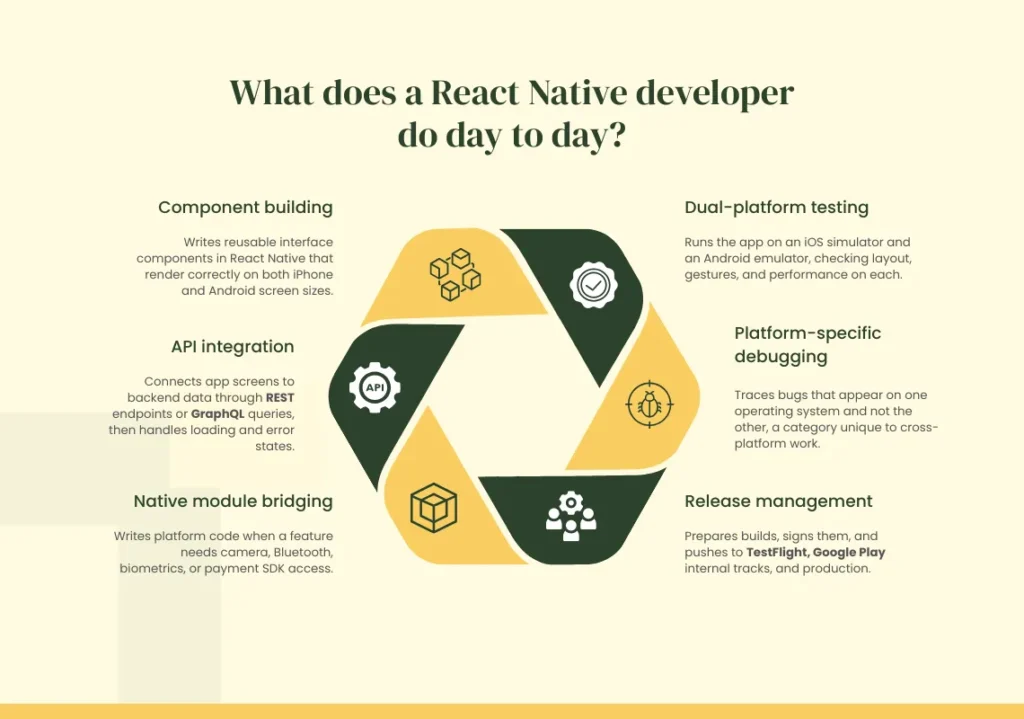
A React Native developer performs 6 recurring daily tasks: building cross-platform components, integrating APIs, bridging native modules, testing on iOS and Android simulators, resolving platform-specific bugs, and shipping releases to the App Store and Google Play. Most of this happens inside two-week sprints tracked in Jira or ClickUp.
- Component building: Writes reusable interface components in React Native that render correctly on both iPhone and Android screen sizes.
- API integration: Connects app screens to backend data through REST endpoints or GraphQL queries, then handles loading and error states.
- Native module bridging: Writes platform code when a feature needs camera, Bluetooth, biometrics, or payment SDK access.
- Dual-platform testing: Runs the app on an iOS simulator and an Android emulator, checking layout, gestures, and performance on each.
- Platform-specific debugging: Traces bugs that appear on one operating system and not the other, a category unique to cross-platform work.
- Release management: Prepares builds, signs them, and pushes to TestFlight, Google Play internal tracks, and production.
That last item catches teams by surprise, which is why anyone planning to hire a React Native developer should confirm whether store release ownership sits inside the role or with a separate DevOps person.
A realistic day in a React Native developer’s workflow
- Joins standup and reports yesterday’s progress against the sprint board.
- Picks up a ticket, reads the design spec, and confirms edge cases with the designer.
- Builds the component in React Native and wires it to state.
- Runs the screen on both an iOS simulator and an Android emulator side by side.
- Fixes the Android-only layout break that the iOS build never showed.
- Opens a pull request and responds to code review comments.
- Hands the branch to QA and picks up the next ticket.
How does a React Native developer work with native code?
A React Native developer writes native code in Swift, Objective-C, Kotlin and Java when a feature requires direct access to device hardware or a platform-only SDK. This is the part of the job that job listings skip, and it’s the clearest line between a React Native developer and a React web developer.
React Native ships with modules for common needs, and the library ecosystem covers many more. Four situations still force custom native work: an unsupported hardware sensor, a vendor SDK with no JavaScript wrapper, a performance-critical operation, and a platform API released faster than the community wrapped it. TurboModules register these native pieces so JavaScript can call them directly.
The sequence runs one direction. A product requirement arrives, the React Native developer writes a native module in Kotlin for Android and Swift for iOS, exposes the module’s methods to the JavaScript layer, and then consumes those methods inside an ordinary React component. From the app code’s perspective, a fingerprint scanner ends up looking like a function call.
What skills does a React Native developer need?
A React Native developer needs JavaScript and TypeScript fluency, React component architecture, state management, mobile build tooling, and native platform configuration. Employers typically ask for 3 to 5 years of combined React and mobile experience at mid-level.
Core technical skills
- JavaScript ES6+: Async patterns, destructuring, and module syntax underpin every React Native file a developer touches.
- TypeScript: Type safety across a growing mobile codebase catches interface mismatches before a build reaches QA.
- React hooks: useState, useEffect, and custom hooks handle component logic and side effects.
- State management: Redux Toolkit or Zustand holds app-wide data such as auth sessions, cart contents, and cached listings.
- API integration: REST and GraphQL consumption, plus caching layers like React Query.
- Git version control: Branching, rebasing, and pull request workflows on shared repositories.
Platform-specific knowledge
- Xcode configuration: Build schemes, capabilities, and Info.plist permissions for iOS releases.
- Android Studio and Gradle: Build variants, dependency resolution, and manifest permissions.
- Code signing: Provisioning profiles, certificates, and keystore management across both stores.
- Hermes tuning: Bundle size reduction and startup time profiling on lower-end Android devices.
Collaboration skills on distributed teams
A React Native developer working remotely needs written clarity, timezone discipline, and documentation habits. Async communication carries the weight that hallway conversations carry in an office, so ticket comments and pull request descriptions have to stand alone.
Teams hiring dedicated React Native developers usually set a 4-hour overlap window for standups and live code review. Documentation matters more on mobile than web, because a native module written once gets debugged by someone else eighteen months later.
What does a React Native developer not do?
A React Native developer doesn’t own backend architecture, original interface design, native game engine development, or production DevOps infrastructure. Four exclusions define the boundary, and hiring managers who blur them end up with a mismatched hire.
- Backend architecture: Database schema design, server infrastructure, and API authoring belong to backend engineers.
- Original UI design: A React Native developer implements designs from Figma, and a product designer creates them.
- Native game engines: Graphics-heavy 3D work runs on Unity or native Metal and Vulkan rendering, outside React Native’s scope.
- Production DevOps: Server monitoring, container orchestration, and cloud infrastructure sit with a platform team.
- Advanced AR work: Deep ARKit and ARCore implementations need dedicated native specialists.
Scope confusion drives most bad mobile hires, so anyone reading up on how to hire a React Native developer benefits from writing these exclusions into the job description before the first interview.
What tools does a React Native developer use?
A React Native developer works across 5 tool categories: development environment, state management, testing, build and release, and crash monitoring. The stack stays fairly standard across teams, which shortens onboarding.
- Development environment: VS Code for editing, Metro as the bundler, and Expo for managed workflows and over-the-air updates.
- State management: Redux Toolkit for large apps and Zustand for lighter state needs.
- Testing: Jest for unit tests, Detox for end-to-end flows, and Flipper for runtime inspection.
- Build and release: Fastlane for automated signing and upload, plus EAS Build for cloud builds without local Xcode.
- Crash monitoring: Sentry and Firebase Crashlytics surface production errors with stack traces from real devices.
Tooling maturity separates a senior React Native developer from a junior one, and it feeds directly into the cost to hire a React Native developer, since automated pipelines cut weeks off every release cycle.
Frequently asked questions
Is React Native still in demand in 2026?
Yes, React Native remains one of the most widely adopted cross-platform mobile frameworks. Teams building for both iPhone and Android with limited engineering headcount keep choosing it. Meta continues maintaining the framework, and the New Architecture rollout signals active long-term investment.
Do React Native developers need to know Swift or Kotlin?
Yes, at mid-level and above. Junior React Native developers work almost entirely in JavaScript. Senior React Native developers read and write Swift and Kotlin to debug native modules and integrate vendor SDKs that lack JavaScript wrappers.
Can a React developer become a React Native developer?
Yes, and the transition typically takes 2 to 3 months. React knowledge covers roughly 60% of the work, since components, hooks, and state management carry over directly. The learning curve sits in mobile build tooling, simulator debugging, and store submission. Many teams recruiting a cross-platform app developer accept strong React experience with a portfolio of one shipped mobile app.
How long does a React Native developer take to build an app?
A simple app takes 6 to 10 weeks, and a feature-rich app takes 4 to 6 months. Timeline drivers include screen count, native integrations, backend readiness, and app store review cycles.
Do React Native developers submit apps to the App Store?
Yes, in most teams. A React Native developer prepares the build, manages code signing, uploads through Fastlane or Xcode, and responds to reviewer rejections. Larger organisations split this task with a release engineer.
Is React Native better than Flutter?
React Native suits teams with existing JavaScript talent, and Flutter suits teams starting fresh with a preference for Dart. Hiring is the deciding factor for most companies, and the React Native vs Flutter comparison comes down to which language your team already writes.
What is the New Architecture in React Native?
The New Architecture replaces the old JavaScript bridge with Fabric for rendering and TurboModules for native calls. Both allow direct synchronous communication between JavaScript and native code, cutting the latency the bridge introduced. React Native made it the default from version 0.76.
Closing
So, what does a React Native developer do? A React Native developer takes a product idea and ships it to iOS and Android from one codebase, handling components, native modules, testing, and store releases along the way.
The React Native developer role covers more platform-native ground than most job descriptions admit, and the strongest candidates move comfortably between JavaScript and Swift or Kotlin.
Teambuild Consultancy places dedicated remote React Native developers with UK businesses on fixed monthly retainers, with payroll and HR handled in full.