Hiring a Java developer in the UK is not just about finding someone who knows the language. Most Java roles involve maintaining live systems that a business already depends on, so the real question is whether a candidate can work safely inside code they did not write.
This guide walks through the skills to check, how to test them, what a Java developer actually costs in the UK, and the two hiring routes available to you.
What Is a Java Developer?
A Java developer builds and maintains backend systems, enterprise applications, and Android apps written in Java. UK banks, insurers, logistics firms, and large e-commerce platforms still run core systems on Java, which means a lot of the job is maintenance and integration work rather than building something new from scratch.
Before you write a job ad, it helps to know exactly what the role covers day to day, which tools a Java developer typically uses, and how it differs from a general backend role. See our full breakdown of what does a java developer do for the complete picture.
Skills and Qualifications to Look For
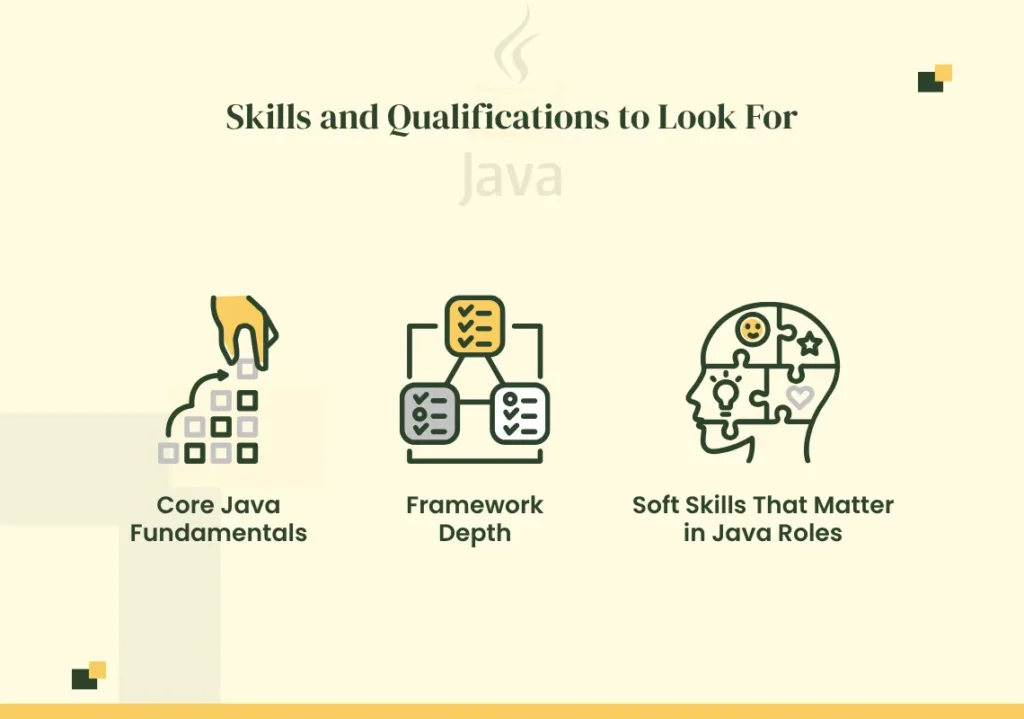
Hiring the right Java developer in the UK starts with a clear skills list, not a job title.
Core Java Fundamentals
Look for solid knowledge of object-oriented programming, the Java Virtual Machine (JVM), memory management, garbage collection, and multithreading. These fundamentals separate developers who can debug a production issue at 6pm from those who can only follow along with a tutorial.
Framework Depth
Most UK Java roles run on Spring or Spring Boot, with Hibernate for database work and Maven or Gradle for builds. A candidate can know Java well and still be weak on these frameworks, so test the two separately. Ask about dependency injection, REST API design in Spring Boot, and how they structure a service layer.
Soft Skills That Matter in Java Roles
Java developers usually inherit code written by someone else years earlier. Strong candidates communicate clearly about technical debt, document their changes, and ask the right questions before touching a live system. This matters more in Java hiring than in most other languages, since so much Java work is legacy maintenance rather than new builds.
How to Test a Java Developer’s Skills (Without Being One Yourself)
You do not need to write Java yourself to judge it well. Two methods work better than a generic coding test.
The Code-Review Exercise
Give the candidate a real Spring Boot service, with any sensitive details removed, and ask them to review it. Their notes tell you more than a syntax quiz. A developer who spots unclear naming, missing error handling, or a security gap understands Java in practice, not just in theory. This exercise also shows you how they explain technical problems to a non-technical hiring manager, which matters once they join your team.
A Practical Task Tied to Your Stack
Set a small task using your actual tech stack rather than a generic algorithm puzzle. A Java developer joining a UK business to maintain existing systems needs to show they can work with real, imperfect code, not just solve an abstract problem from scratch. Keep the task short, under two hours, and focused on something close to the work they would actually do.
The Java Developer Interview Scorecard
Use this scorecard to keep every interview consistent and fair, and to compare candidates on the same basis.
| Criteria | What Good Looks Like | Weight |
|---|---|---|
| Language fundamentals | Explains JVM behaviour, memory management, and concurrency clearly, with real examples | 30% |
| Framework and system design | Comfortable with Spring Boot and Hibernate, and can reason about design for scale | 40% |
| Soft skills and collaboration | Communicates technical debt clearly and asks clarifying questions before acting | 30% |
Score each candidate against all three areas, not just the technical questions. A Java developer who scores well on language fundamentals but poorly on framework depth will struggle with real UK enterprise projects, where Spring Boot and Hibernate are the standard, not the exception.
Java vs Python for Backend Work: Does It Change Your Hiring Approach?
If you are still unsure whether Java is the right call, it is worth a quick comparison before you commit to a hiring plan. Java tends to suit large, long-running enterprise systems with heavy transaction volume and strict uptime requirements, while Python often wins for faster prototyping and data-heavy projects.
Read our full comparison of java vs python backend development if you want to weigh the two before posting a job ad.
What Does It Cost to Hire a Java Developer in the UK?
The median UK Java developer salary is £67,500 a year, before Employer National Insurance and recruiter fees (Source: IT Jobs Watch). Add roughly 13.8% Employer NI on top of that salary, plus a typical recruiter fee of 15 to 25% of first-year pay, and the real cost of an in-house Java hire climbs well past the number on the job ad.
These hidden costs are the part most hiring guides skip entirely. For a full cost breakdown, including part-time and full-time dedicated hire pricing from Teambuild, see cost to hire a java developer.
Where to Hire: In-House Recruitment vs. a Dedicated Java Developer
UK businesses hiring a Java developer usually choose between two routes.
Hiring In-House
This route gives you full control over the hire, but it comes with a slower timeline, typically 4 to 8 weeks from job ad to start date, plus Employer NI, recruiter fees, and onboarding overhead once the developer joins.
Hiring a Dedicated Java Developer Through Teambuild
Teambuild places pre-vetted, dedicated Java developers with UK businesses on a flat monthly retainer, part-time or full-time. Your developer integrates into your team like an employee, while Teambuild handles payroll, onboarding, and admin in the background. This route cuts weeks off your hiring timeline and removes the NI and recruiter fee stack entirely.
If you want a Java developer ready to start without the recruitment overhead, hire a java developer through Teambuild.
FAQ
How much does it cost to hire a Java developer in the UK?
The median salary is £67,500 a year, before Employer NI and recruiter fees. See our cost to hire a java developer page for the full breakdown, including dedicated hire pricing.
What skills should a Java developer have?
Strong Java fundamentals, hands-on experience with Spring Boot and Hibernate, and the ability to work confidently inside existing legacy code.
Is it cheaper to hire a Java developer in-house or through a dedicated placement?
A dedicated placement through Teambuild often costs less overall once you account for NI, recruiter fees, and the weeks lost to in-house recruitment.
How long does it take to hire a Java developer in the UK?
In-house recruitment typically takes 4 to 8 weeks. A dedicated Java developer through Teambuild can start significantly faster, since candidates are already vetted.
What’s the difference between a Java developer and a full-stack developer?
A Java developer focuses on backend systems built in Java. A full-stack developer works across both frontend and backend. Read more about what does a full-stack developer do.