TL;DR
This piece reframes the Java vs Python debate as a hiring decision for UK businesses, not a language popularity contest. It covers performance, development speed, and UK talent pool differences, then anchors on the core hook: as of September 2026, UK Python developers cost more than Java developers on median salary (£70,000 vs £67,500), a reversal most competitor content misses. A scenario-based decision framework and a CTA route Java-leaning readers into Teambuild’s hiring cluster.
Choosing between Java and Python for your backend is really a hiring decision in disguise. The language you pick determines who you can hire, how fast they can ship, and what it costs you in the UK market right now. Here’s how the two compare, and how to decide which one fits your project.
Java vs Python at a Glance
Java is a compiled, statically typed language built for large-scale, high-performance systems. It powers core banking platforms, insurance systems, and enterprise backends across the UK, and most Java work involves maintaining and extending systems that are already running.
Python is an interpreted, dynamically typed language known for readability and speed of development. It dominates AI, machine learning, and data-heavy applications, and it works well for backends that prioritise getting to market fast over squeezing out maximum performance.
If you want the full picture of what a Java developer actually does day to day, see what does a java developer do.
Performance and Scalability
Java has the edge on raw performance. Its JVM compiles code ahead of execution and optimises it further at runtime, and its native multithreading makes it a strong fit for high-transaction systems that can’t afford to slow down under load. This is why Java remains common in banking, payments, and logistics platforms, where a slow response under peak load has a direct cost.
Python trades some of that speed for developer convenience. For most backend work, this trade-off barely matters. Standard business APIs, internal tools, and typical SaaS backends rarely hit the ceiling where Java’s performance edge becomes decisive. What usually matters more is which stack your team already runs, since rewriting a working system rarely pays for itself. A Python backend handling a few hundred requests per second for an internal admin tool will not run meaningfully slower than the same tool built in Java.
Development Speed and Ecosystem
Spring Boot gives Java a mature, structured framework that scales well across larger engineering teams, but that structure comes with more upfront setup. Configuration, dependency injection, and a stricter project layout all add a learning curve before a new developer can ship confidently.
Django and Flask let Python teams move faster in the early stages, with less boilerplate and quicker iteration. Django in particular ships with a lot of functionality out of the box, including an admin panel and an ORM, which suits smaller teams that need to move without building everything from scratch.
For a small team building a straightforward backend, Python’s ecosystem usually gets you to a working product sooner. For a larger team building something that needs to scale across many services over several years, Spring Boot’s structure tends to pay off, since the same conventions that slow down a solo developer keep a bigger team consistent.
UK Talent Pool for Each
Both languages have a strong developer base in the UK, but the shape of that talent pool has shifted. Java retains a deep bench of developers experienced in enterprise systems and legacy maintenance, which matches what most UK businesses actually need a Java hire for. Python’s talent pool has increasingly concentrated around AI, machine learning, and data engineering roles, so a Python developer with strong backend-specific experience, rather than a data science background, can be harder to find than the raw candidate numbers suggest.
What Does Each Cost to Hire in the UK?
As of September 2026, the median UK Python developer salary (£70,000) is actually higher than the median Java developer salary (£67,500), according to IT Jobs Watch. That’s a reversal of what most comparison guides assume.
| Metric | Java Developer | Python Developer |
| Median UK salary | £67,500 | £70,000 |
| 25th–75th percentile | £60,000–£83,750 | £56,250–£90,000 |
| Year-on-year change | -6.9% | -17.65% |
Python’s steeper year-on-year decline suggests the talent pool is growing faster than demand for backend-specific Python roles, likely because so much current Python hiring has shifted toward AI and data work rather than traditional backend development.
For the full breakdown of what a Java hire costs once you add Employer NI and recruiter fees, see cost to hire a java developer.
Java vs Python: Which Should You Hire For?
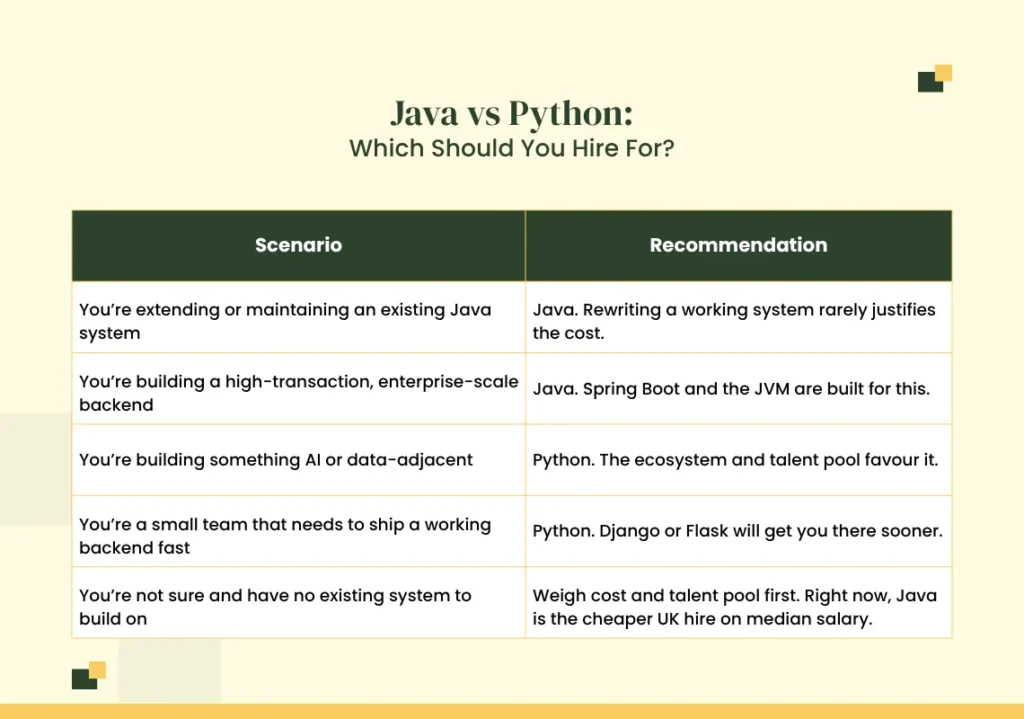
Use this as a starting point, not a rulebook.
| Scenario | Recommendation |
| You’re extending or maintaining an existing Java system | Java. Rewriting a working system rarely justifies the cost. |
| You’re building a high-transaction, enterprise-scale backend | Java. Spring Boot and the JVM are built for this. |
| You’re building something AI or data-adjacent | Python. The ecosystem and talent pool favour it. |
| You’re a small team that needs to ship a working backend fast | Python. Django or Flask will get you there sooner. |
| You’re not sure and have no existing system to build on | Weigh cost and talent pool first. Right now, Java is the cheaper UK hire on median salary. |
Ready to Hire a Java Developer?
If Java is the right fit for your project, you don’t need to run a full UK recruitment cycle to get one. Teambuild places pre-vetted, dedicated Java developers with UK businesses on a flat monthly retainer, part-time or full-time. Your developer works as part of your team, while Teambuild handles payroll, onboarding, and admin.
Start with our guide on how to hire a java developer for the full hiring process, or go straight to hire a java developer if you’re ready to bring someone on.
FAQ
Is Java or Python better for backend development?
Neither is universally better. Java suits high-performance, enterprise-scale systems and extending existing Java codebases. Python suits faster-shipping teams and AI or data-heavy backends.
Is Python cheaper to hire than Java in the UK?
Not currently. As of September 2026, the median UK Python developer salary (£70,000) is higher than the median Java developer salary (£67,500), according to IT Jobs Watch.
Which is faster, Java or Python?
Java is faster at runtime thanks to JVM compilation and native multithreading. Python trades some raw speed for development convenience, which rarely matters for typical backend workloads.
Should I hire a Java developer or a Python developer for my startup?
It depends on what you’re building. If your product is AI or data-driven, Python’s ecosystem fits better. If you’re building a transaction-heavy or enterprise-scale backend, Java is the stronger long-term fit, and currently the cheaper UK hire on median salary.