Flutter is Google’s open-source UI toolkit using the Dart programming language. It creates native-quality mobile apps for Android, iOS, and desktop from one codebase. The demand for Flutter developers has increased as it now supports apps in fintech, e-commerce, and healthcare.
This guide outlines four key areas businesses must address before hiring:
- The right engagement model for the project
- Where to find qualified Flutter talent
- How to assess developers
- and how Flutter stacks up against React Native
Startup founders, product managers, and UK business owners planning cross-platform mobile apps will find a clear process for hiring a Flutter developer that fits their timeline, budget, and technical needs.
TL;DR
- Flutter developers are hired under 3 models: freelance, agency outsourcing, or dedicated remote staffing
- The best sources to find Flutter talent include Upwork, LinkedIn, GitHub communities, specialist boards, and staffing partners
- Evaluate every Flutter developer across 4 checkpoints: portfolio, technical screening, soft skills assessment, and a paid trial
- Flutter beats React Native on UI consistency and cross-platform rendering. React Native suits teams already working in JavaScript
- Dedicated remote Flutter developers cost £900 to £3,500 per month through Teambuild Consultancy, London, with payroll and HR fully managed
What Are the Engagement Models for Hiring Flutter Developers?
Flutter developers are available through three main models: freelance hire, agency outsourcing, and dedicated remote staffing. Each model is designed for different project scopes, budgets, and timelines.
Picking the wrong model at the start of a mobile app project often leads to missed deadlines and contractor turnover during development.
Freelance Flutter developer
Freelancers on platforms like Upwork are good for short-term projects or single features. They usually cost less upfront but don’t guarantee continuity during a multi-sprint development. Freelance work is best when the project scope is clear, deliverables are defined, and the business has an in-house team to oversee the handover.
Agency outsourcing
Agencies provide Flutter development services that include project management, UI design, and software development in one contract. This option is ideal for businesses with fixed deliverables and no internal resources to manage developers. Agency costs are generally higher than freelance rates, and businesses often work with a rotating team instead of a single developer.
Dedicated remote Flutter developer
A dedicated Flutter developer focuses solely on one company’s product. They align with the company’s workflow, brand standards, and long-term app development plans. This model is perfect for companies that build and refine an app over six months or more, as it reduces onboarding costs for new feature cycles through continuity of codebase knowledge.
Businesses comparing cross-platform and native approaches before committing to a model will find the native vs cross-platform app development breakdown a useful starting point. The framework choice directly shapes the developer profile required.
Where Do You Find Flutter Developers to Hire?
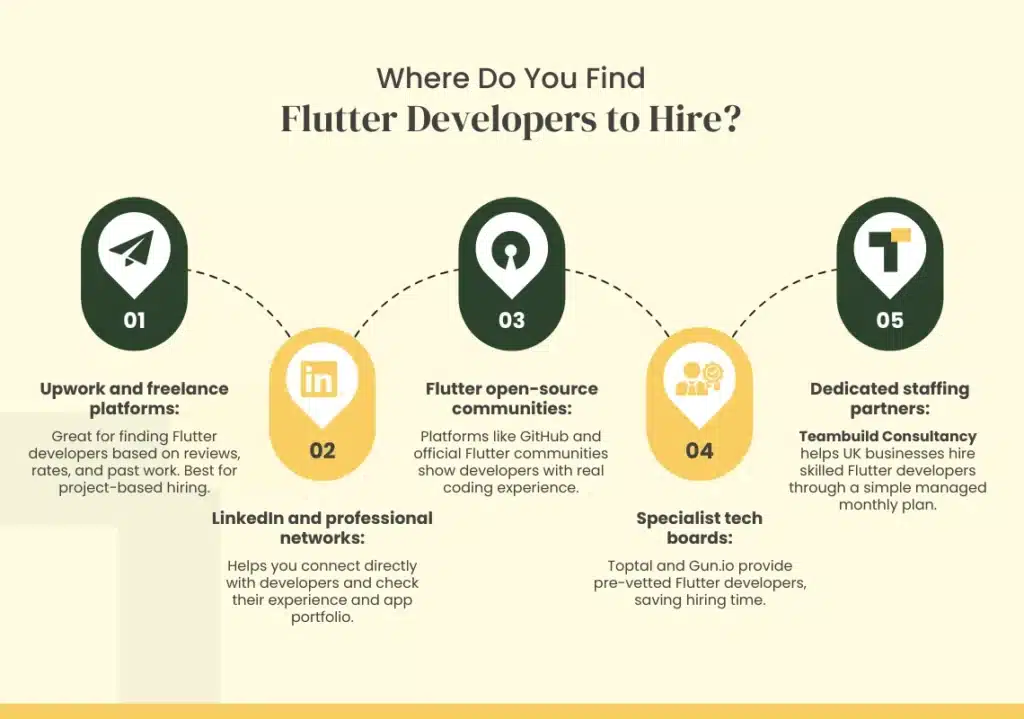
Flutter developers come from five main channels: freelance marketplaces, professional networks, open-source communities, specialist tech boards, and dedicated staffing partners.
Each channel offers a unique developer profile. Freelance marketplaces provide a broad selection. Open-source communities offer in-depth framework knowledge. Staffing partners deliver pre-vetted, dedicated talent that fits the client’s needs. Choosing the right channel can save 2 to 4 weeks of screening time for mobile app hires.
- Upwork and freelance marketplaces: Upwork has a large pool of Flutter developers. You can filter by portfolio rating, hourly rate, and project history. Freelance marketplaces work well for project-based needs with a clear scope and budget.
- LinkedIn and professional networks: LinkedIn lets you reach out directly to Flutter developers with verified work history and published portfolios. Developers with 3 or more years in Flutter often showcase named apps they’ve created, making it easier to assess portfolio quality.
- Flutter and Dart open-source communities: The Flutter GitHub repository and official Discord communities highlight developers actively contributing to the framework. These developers show real codebase experience, including state management, API integration, and widget architecture, which a typical CV can’t verify.
- Specialist tech boards: Boards like Toptal and Gun.io pre-screen Flutter developers against specific technical benchmarks. This reduces false positives, cutting the average screening rounds from 4 to 2 per hire.
- Dedicated staffing partners: Teambuild Consultancy, located at Level 18, 40 Bank Street, Canary Wharf, London, connects UK businesses with vetted Flutter developers through a managed monthly arrangement. Businesses deciding whether to focus on Android, iOS, or can hire an app developer easily from Teambuild Consultancy.
Note: Platform scope and developer profile are important aspects to consider together.
How to Evaluate a Flutter Developer Before You Hire
Businesses assess a Flutter developer through four main steps: portfolio review, technical screening, soft skills assessment, and a paid trial project.
Skipping any step increases risk. A developer who passes the portfolio review but fails the technical screening can waste 3 to 5 days of interview time. If they pass both but fail the trial project, it can delay delivery by at least 2 weeks. Following all four steps is the best approach, even under pressure.
UK businesses using Teambuild Consultancy’s process get a pre-screened Flutter developer who has cleared all four steps before starting. This reduces the risk of mis-hire and shortens time-to-productivity to under 7 days.
Review the Flutter portfolio
Look at apps made with Flutter on Google Play or the App Store. Check UI quality, cross-platform consistency, and feature complexity, like API connectivity, Firebase integration, and graphical widget use. A portfolio lacking shipped apps is a major red flag for mid-level or senior hires.
Run a technical screening
Give a timed task that covers Dart language use, state management, and basic integration testing. Senior developers should complete this task in 2 to 4 hours. The results show code organization, error handling, and testing practices before any live interview.
Assess communication and workflow fit
Interview the developer based on your project management process. Flutter developers need structured onboarding, sprint-aligned delivery, and clear written communication throughout the project. A developer who communicates reactively adds extra work for the project manager at every milestone.
Assign a paid trial project
Set a limited feature build lasting 1 to 2 weeks. A trial project reveals code quality, reliability, and collaboration before full engagement. Paid trials are the most dependable indicator of real-world performance, more so than portfolios or screening tasks alone.
Should You Choose Flutter or React Native for Your Next App?
Flutter delivers superior UI consistency and cross-platform rendering performance compared to React Native, making Flutter the stronger choice for businesses prioritising pixel-accurate design across Android, iOS, and desktop from a single codebase.
The rendering architecture explains the difference. Flutter uses its own Impeller rendering engine. The engine draws every graphical widget directly to the screen using Dart, with no dependency on native platform components. React Native takes a different approach. It bridges JavaScript to the native UI components of each platform. That bridge causes rendering issues on Android and iOS. Each platform needs specific fixes to solve these problems.
For products where user interface fidelity is a competitive differentiator, particularly in fintech and e-commerce, Flutter’s rendering model eliminates an entire category of front end and back end reconciliation overhead.
The language trade-off is also relevant. Flutter depends on Dart. So, to hire a Flutter developer, you need to check their Dart skills first. This is key. In comparison, React Native teams can pull from a larger pool of JavaScript talent. Both frameworks lower mobile app development costs compared to managing separate Kotlin and Swift codebases.
React Native suits organizations with existing JavaScript engineering knowledge. Flutter suits organizations where UI performance and cross-platform consistency are primary product requirements.
The full technical breakdown is covered in the React Native vs Flutter comparison, which covers how each framework handles iOS and Android deployment differently.
Frequently Asked Questions: How to Hire a Flutter Developer
Do Flutter developers need to know both Android and iOS development?
No. Flutter developers build for Android and iOS simultaneously from a single Dart codebase, so platform-specific knowledge of Kotlin or Swift is not a prerequisite. Flutter developers benefit from understanding platform-specific UI guidelines for Android and iOS to ensure each app meets its respective app store’s UX and submission requirements. This is design familiarity rather than native development skill.
How long does it take to hire a Flutter developer?
Hiring a Flutter developer through a freelance marketplace takes 3 to 10 business days for shortlisting and screening. Hiring through Teambuild Consultancy in London reduces the process to 5 to 7 business days, as developer vetting is completed before placement, removing the candidate filtering stage from the client’s timeline entirely.
Can a Flutter developer build web and desktop apps, not just mobile apps?
Yes. Flutter supports web, desktop, and mobile application targets from the same Dart codebase. A Flutter developer with multi-platform experience extends a single mobile app to additional platforms, including desktop computer and browser environments, without a separate software development kit or additional engineering team. The same codebase compiles to all 6 supported targets: Android, iOS, web, Windows, macOS, and Linux.
What is the difference between hiring a freelance Flutter developer and a dedicated Flutter developer?
A freelance Flutter developer works across multiple clients simultaneously and suits single-project engagements with a fixed deliverable. A dedicated Flutter developer works exclusively on one company’s product, integrates into the team’s workflow, and delivers continuity across the full software development lifecycle.
Your Next Step: How to Hire a Flutter Developer Through Teambuild
The process for how to hire a Flutter developer follows a clear sequence: define the engagement model first, identify the right sourcing channel for that model, run all 4 evaluation checkpoints, and confirm the framework decision before the developer begins work on the codebase.
Businesses that skip the model decision and go straight to job boards consistently end up re-hiring within 3 months. A freelance developer hired for a 6-month product build and a dedicated remote developer are different hires solving different problems. Getting the model right is the single highest-leverage decision in the process.
Teambuild Consultancy, located at Level 18, 40 Bank Street, Canary Wharf, E14 5NR, London, places dedicated Flutter developers with UK businesses under monthly packages where payroll and HR management are handled by Teambuild. Part-time packages run from £900 to £1,500 per month.
Full-time packages run from £1,500 to £3,500 per month. Both tiers provide a dedicated developer, not a shared resource, aligned exclusively to the client’s cross-platform mobile application roadmap from day one.