Native vs cross platform app development is the decision every product team faces before shipping a mobile app. Native app development builds separate iOS and Android applications using Swift, Kotlin, Java, or Objective-C.
Cross-platform app development writes one codebase that runs on both operating systems through React Native, Flutter, or similar frameworks. The choice influences the budget, launch timeline, and user experience for years.
Teambuild Consultancy connects UK businesses with remote developers for mobile app projects. This question comes up in about 8 out of 10 placement calls. Here’s the side-by-side breakdown that settles the native vs cross-platform decision for product teams in 2026.
TL;DR
- Native app development builds separate iOS and Android apps in Swift, Kotlin, Java, or Objective-C
- Cross-platform app development uses one codebase across both operating systems through frameworks like React Native and Flutter.
- Native apps deliver 30% to 40% better performance on graphics-heavy and hardware-dependent features
- Cross-platform apps cut development costs by 30 to 50% and ship 2 to 3 months faster on average
- The right choice depends on several factors: budget, performance needs, target audience, and access to native UI elements.
What Is Native App Development?
Native app development is the process of building a mobile application for a specific platform using that operating system’s official programming language and software development kit. iOS apps run on Swift and Objective-C inside Xcode. Android apps run on Kotlin and Java inside Android Studio.
Native code connects directly to the iOS SDK and Android SDK. This allows full access to native UI components, GPS, camera, microphone, and other hardware sensors.
Each operating system needs its own codebase, so a native product ships as 2 separate apps maintained side by side. Average native iOS app size sits around 38 MB after compilation.
UK product teams hiring through Teambuild Consultancy for native mobile builds typically split projects across dedicated iOS and Android specialists working in parallel.
What Is Cross-Platform App Development?
Cross-platform app development is the process of building one codebase that runs on multiple mobile operating systems through frameworks like React Native, Flutter, and Xamarin. React Native, built by Meta Platforms, uses JavaScript and React to render native UI elements on iOS and Android from a single shared codebase.
Flutter, built by Google, uses Dart and compiles to native bytecode for both platforms with full control over UI rendering. One codebase covers around 90% of platform features, and the remaining 10% ships through platform-specific modules.
The shared codebase reduces duplicate work across business logic, layouts, and API integrations. UK startups hiring developers through Teambuild Consultancy often pick cross-platform frameworks for MVP builds because one team ships to iOS and Android in parallel.
Native vs Cross-Platform: Key Differences at a Glance
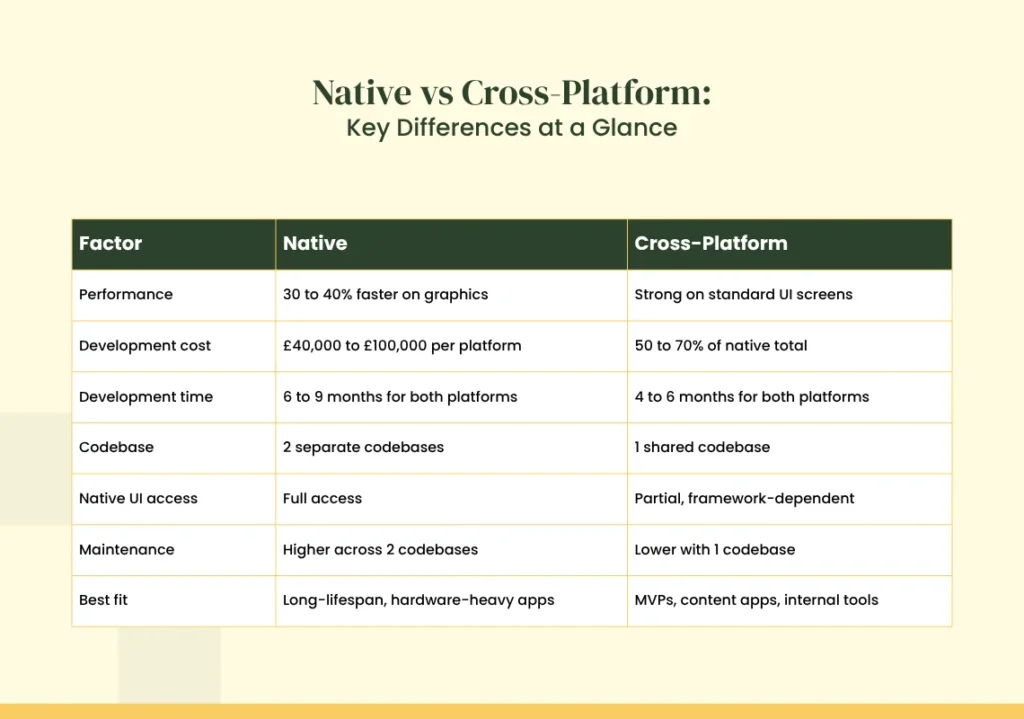
Native and cross-platform development differ in six key areas:
- Performance
- Development cost
- Development time
- User experience
- Native feature access
- Maintenance overhead
The comparison below sets out how each approach performs on every metric that affects a real mobile app build.
Factor | Native | Cross-Platform |
Performance | 30 to 40% faster on graphics | Strong on standard UI screens |
Development cost | £40,000 to £100,000 per platform | 50 to 70% of native total |
Development time | 6 to 9 months for both platforms | 4 to 6 months for both platforms |
Codebase | 2 separate codebases | 1 shared codebase |
Native UI access | Full access | Partial, framework-dependent |
Maintenance | Higher across 2 codebases | Lower with 1 codebase |
Best fit | Long-lifespan, hardware-heavy apps | MVPs, content apps, internal tools |
Teambuild Consultancy in the UK has dedicated app developers for both routes. We offer specialists in native iOS, native Android, React Native, and Flutter on a monthly retainer.
Pros and Cons of Native App Development
Native app development offers 4 measurable advantages and 3 measurable drawbacks for product teams building mobile applications. The trade-off sits between top-end performance and project cost.
Pros of native app development | Cons of native app development: |
Native apps render graphics, animations, and 3D scenes 30 to 40 percent faster than cross-platform equivalents. | Native projects run £40,000 to £100,000 per platform, which doubles for full iOS plus Android coverage. |
Native code unlocks GPS, camera, microphone, and sensor APIs without third-party wrappers. | 2 separate codebases extend the build phase by 2 to 3 months on average. |
Native apps load faster and crash less, which feeds App Store and Google Play ranking algorithms. | Bug fixes, OS updates, and feature releases ship twice for each version. |
Native iOS apps integrate with iOS 11 and later system features; native Android apps tap directly into Android software development kits. |
Pros and Cons of Cross-Platform App Development
Cross-platform app development offers 4 cost and speed advantages and 3 technical trade-offs for teams shipping mobile apps on a single codebase. The balance favours speed and reach over peak hardware performance.
Pros of cross-platform app development | Cons of cross-platform app development |
Cross-platform frameworks like React Native and Flutter run one codebase across iOS and Android, which cuts duplicate work. | Cross-platform apps run 10 to 25 percent slower than native equivalents on animation-heavy and 3D-graphics screens. |
Cross-platform projects ship 2 to 3 months earlier than native equivalents on most MVP builds. | Some platform-specific APIs need custom native modules outside the shared codebase. |
Cross-platform projects cost 50 to 70 percent of a native build for the same feature set. | Cross-platform projects rely on framework updates from Meta Platforms, Google, and JetBrains, which sets the upgrade cadence. |
Changes to business logic deploy across both platforms from one push. |
UK businesses looking to hire cross-platform developers can find dedicated React Native, Flutter, and Xamarin engineers through Teambuild Consultancy on a monthly retainer.
When Should You Choose Native App Development?
Choose native app development when your mobile app depends on hardware access. It’s ideal for advanced graphics. Also, it suits long product lifecycles and high user retention targets. The native route earns its higher cost on projects where performance and platform depth matter more than speed to market.
Use cases that suit native app development:
- Graphics-heavy mobile games: Games built on Unity or native game engines need maximum frame rates and direct GPU access.
- Hardware-dependent apps: Apps with deep GPS, camera, microphone, and sensor integration ship more reliably on native code.
- Security-critical financial apps: Banking and fintech apps with strict iOS and Android security requirements stay native for compliance reasons.
- Long-lifespan products: Products with 5+ year roadmaps recoup the native build cost over time.
When Should You Choose Cross-Platform App Development?
Choose cross-platform app development when budget, time to market, and reach across iOS and Android matter more than peak hardware performance. The cross-platform route fits MVPs, content apps, and internal tools far better than long-lifespan native builds.
Use cases that suit cross-platform app development:
- MVP launches under tight deadlines: Startups with 6-month launch windows ship cross-platform first to validate before going native.
- Lean startup budgets: Companies with budgets under £50,000 cover both platforms through one cross-platform codebase.
- Content and e-commerce apps: Apps with standard UI patterns and lighter hardware demands run well on React Native and Flutter.
- Internal business tools: Internal apps used across MacOS, Microsoft Windows, and Linux teams gain from one shared codebase.
UK businesses creating cross-platform apps often hire Flutter developers for better performance. Teams already using React usually choose React Native developers from Teambuild Consultancy for quicker onboarding.
Cost Comparison: Native vs Cross-Platform App Development
Native app development costs 30% to 50% more than cross-platform development. This includes build, testing, and Year 1 maintenance. The gap grows larger for apps that release feature updates every quarter.
| Phase | Native (Both Platforms) | Cross-Platform |
| Initial build | £80,000 | £45,000 |
| QA and testing | £15,000 | £8,000 |
| Year 1 maintenance | £25,000 | £12,000 |
| Total Year 1 | £120,000 | £65,000 |
UK product teams that want to hire app developer talent for either route plug into Teambuild Consultancy’s bench of native and cross-platform engineers on dedicated monthly contracts.
Frequently Asked Questions
Is React Native better than Flutter for cross-platform development?
React Native and Flutter both rank in the top 2 cross-platform frameworks for mobile app development. React Native uses JavaScript and ships native UI components, which suits teams already on the React stack. Flutter uses Dart, compiles to native bytecode, and gives tighter control over UI rendering. The full breakdown sits in this react native vs flutter comparison.
Can a cross-platform app match native app performance?
Cross-platform apps match native performance on around 80 percent of standard use cases. Performance gaps show up on animation-heavy screens, 3D-graphics workloads, and sensor-intensive features. For content apps, e-commerce stores, and internal tools, the gap stays inside the margin where users notice no difference.
Which approach has lower long-term maintenance cost?
Cross-platform app development carries 40 to 50 percent lower long-term maintenance cost. One codebase replaces 2, so bug fixes, feature releases, and OS-version updates ship once. Native apps require parallel maintenance pipelines across iOS and Android, which doubles the workload for UK product teams scaling through Teambuild Consultancy.
Do native apps rank higher in the App Store and Google Play?
Native apps gain a marginal ranking edge in the App Store and Google Play. Native code loads faster and crashes less, both of which feed App Store and Google Play ranking signals. Cross-platform apps still rank well when the shared codebase is optimised and the framework version stays current.
Picking the Right Mobile App Development Approach
Native vs cross platform app development comes down to 3 questions: what does the app need to do, who is building it, and how long does it need to live? Native app development wins on performance, hardware depth, and long product lifespans. Cross-platform app development wins on cost, speed, and reach across iOS and Android.
Book a discovery call with Teambuild Consultancy to scope the right developer hire for the next mobile app build.