Hiring an app developer in the UK in 2026 starts with 3 decisions: which hiring model fits the budget, whether you’re building native or cross-platform, and which technical skills the developer brings to App Store and Google Play release.
This guide shows UK founders, product owners, and SME decision-makers how to hire an app developer the right way. You’ll find the 4 hiring models, the 6-step process to hire a mobile app developer, monthly rates from £900 to £8,500+, the 8 core skills to vet, and the 5 mistakes that derail UK app projects.
TL;DR
- Choose the right hiring model: UK businesses can hire app developers through 4 routes: in-house employees, freelancers, app development agencies, or dedicated remote developers. Dedicated remote developers typically cost 30–40% less than UK in-house hires.
- Decide between native and cross-platform development early: Native apps (Swift/Kotlin) offer the best performance for fintech, gaming, and IoT products, while Flutter and React Native can reduce development costs by 20–30% and speed up launch timelines.
- Follow a structured hiring process: Define requirements, choose a hiring model, set a budget, shortlist candidates, conduct technical interviews, and secure a contract with IP ownership and post-launch support.
Want to Skip the Hiring Process?
If you’re looking for a faster way to hire an app developer, Teambuild Consultancy provides dedicated remote app developers who work directly within your team as an integrated team member—not as an outsourced resource.
We handle recruitment, screening, payroll, HR, onboarding, and ongoing support, while you manage the developer’s day-to-day work just like any other employee. Every placement also includes a dedicated Customer Success Manager who proactively monitors performance and quickly resolves any issues that arise.
This gives UK startups and SMEs access to experienced app developers without the time, cost, and overhead of traditional hiring.
What Are the 4 Ways to Hire an App Developer in the UK?
Understanding how to hire an app developer begins with choosing the right engagement model for your budget, timeline, and long-term goals. UK businesses hire an app developer through 4 distinct models: in-house employment, freelance engagement, app development companies, and dedicated remote developers via staffing partners.
Each model carries a different cost structure, accountability level, and ramp time. Each model also supports full-time or part-time engagement depending on the project workload.
- In-house developer: Full-time UK employee with daily oversight and direct stakeholder access, suited to multi-year product roadmaps.
- Freelance app developer: Contract engagement sourced from Upwork, Fiverr, or PeoplePerHour, suited to fixed scopes and MVP builds under 12 weeks.
- App development company: Project-based agency contract covering design, build, QA, and project management under one delivery owner.
- Dedicated remote developer: Monthly placement (full-time or part-time) through a staffing partner at 30% to 40% of UK in-house cost, suited to growing startups and SMEs that can’t justify a permanent salary.
Founders weighing the offshore route often work with Teambuild Consultancy, a London-based virtual assistant agency that manages dedicated offshore app developers for UK businesses on full-time or part-time monthly contracts.
How to Hire a Mobile App Developer Step by Step
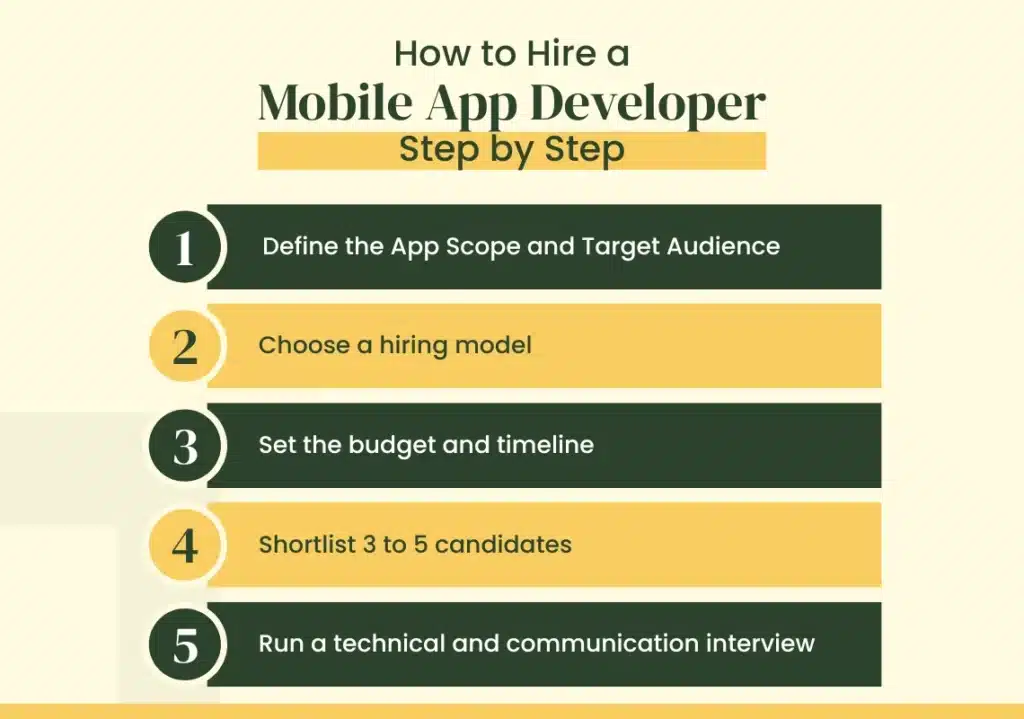
Hiring a mobile app developer follows 6 sequential steps, from defining the app concept to signing the delivery contract.
Step 1: Define the App Scope and Target Audience
Document core features, monetization model (subscription, advertising, transactional, or freemium), and the primary user persona before you contact any developer. A clear scope cuts project cost variance by 30 to 50 percent.
Step 2: Choose a hiring model
You’re matching the 4 hiring options to budget, timeline, and roadmap length. Startups testing an app idea pick freelancers or part-time dedicated remote developers. Enterprises with multi-year roadmaps lean toward full-time in-house teams or app development companies.
Step 3: Set the budget and timeline
Allocate £15,000 to £70,000 for the first build. Reserve 15 to 20 percent of build cost yearly for maintenance, app store updates, and feature releases.
Step 4: Shortlist 3 to 5 candidates
Source from Upwork, Fiverr, Clutch, LinkedIn, and dedicated staffing partners. Review each portfolio for shipped App Store and Google Play releases in a similar category.
Step 5: Run a technical and communication interview
Test platform fluency, API integration, version control, and UK working-hours overlap.
Native or Cross-Platform: Which App Developer Do You Need?
Native development suits performance-critical apps that demand full hardware access. Cross-platform development cuts build cost by 20% to 30% through a shared codebase. Native uses Swift for iOS and Kotlin for Android, with each codebase compiled directly to the operating system.
The native route delivers the fastest performance and the deepest hardware integration. That’s why fintech, gaming, and IoT apps default to native. Cross-platform uses Flutter (Dart) or React Native (JavaScript) to ship one codebase to both the App Store and Google Play, cutting MVP delivery by 4 to 8 weeks.
Decision Factor | Native | Cross-Platform |
Cost | Higher (2 codebases) | 20 to 30% lower |
Performance | Fastest | Near-native |
Best for | Fintech, gaming, IoT | Marketplaces, content, social |
Time to launch | Longer | 4 to 8 weeks faster |
The trade-off between performance, cost, and platform reach explains why every UK app project starts with a clear native vs cross-platform decision before any developer shortlist begins.
What Skills Should You Look for in a Mobile App Developer?
Knowing how to hire a mobile app developer isn’t just about comparing rates. The right technical and communication skills often have a bigger impact on project success than cost alone.
When you hire a mobile app developer for a UK project, look for 8 core skill categories: platform language fluency, UI/UX implementation, API integration, version control, testing, app store deployment, security compliance, and post-launch maintenance.
- Platform language fluency: Match the developer’s primary language to your chosen platform. For Swift and Objective-C builds, hire an iOS app developer with proven App Store releases. Kotlin and Java specialists fall under teams that hire an Android app developer for Google Play deployment. For cross-platform Dart builds, hire a Flutter developer with shipped iOS and Android releases.
- UI/UX implementation: Skill in translating Figma or Adobe XD designs into responsive interfaces that meet user experience design, usability, and responsive web design standards across smartphones and tablet computers.
- API integration: Working knowledge of REST and GraphQL endpoints, payment gateways like Stripe, and third-party SDKs for analytics, push notifications, and authentication.
- Version control: Daily Git workflow including branching strategies, pull request reviews, and CI/CD pipelines.
- Testing and QA: Unit testing, integration testing, and manual QA across multiple devices before each app store release.
- App store deployment: End-to-end publishing on the App Store and Google Play, including provisioning, code signing, and Apple App Review compliance.
- Security compliance: GDPR alignment, encrypted API calls, secure data storage, and OAuth or biometric authentication.
- Post-launch maintenance: Bug fixes, OS update compatibility, and feature roadmap iterations across at least 12 months after launch.
Common Mistakes When Hiring App Developers
UK founders lose budget and timeline on 5 recurring mistakes when they bring on a developer: choosing on price alone, skipping the portfolio review, ignoring post-launch support, hiring before they’ve defined the scope, and overlooking UK working-hours overlap.
A cheap freelancer with no shipped apps generates more rework cost than a mid-tier developer who’s already shipped to the App Store and Google Play. Contracts without a 3-month post-launch maintenance clause leave the mobile application exposed to OS compatibility breaks during the annual iOS and Android updates.
Vague briefs trigger scope creep, which is the leading cause of mobile app development project overruns. A 4-hour daily overlap with the UK team speeds up the development process and cuts the communication delays that hurt customer experience on offshore engagements.
Frequently Asked Questions
How much does it cost to hire a mobile app developer in the UK?
Hiring a mobile app developer in the UK costs £900 to £8,500+ a month depending on seniority, hiring model, and whether you go full-time or part-time. Dedicated remote developers run £900 to £1,800 part-time or £1,800 to £3,500 full-time. UK in-house full-time developers cost £5,000 to £8,500 a month. Full project budgets sit between £5,000 for a simple utility app and £70,000 for a complex marketplace or fintech build.
Should you hire a freelance app developer or an app development company?
Hire a freelance app developer for fixed scopes under 12 weeks and budgets below £25,000. Hire an app development company for multi-stream builds that need design, QA, and project management under one delivery contract. The freelance route saves cost. The agency route reduces coordination risk on complex builds.
How long does it take to hire a mobile app developer in the UK?
UK hiring timelines split by model: 48 hours to 2 weeks through staffing partners, 1 to 4 weeks for vetted freelancers, and 6 to 12 weeks for in-house UK employees. App development companies typically deliver a signed contract within 2 to 3 weeks of brief approval. The first developer is onboarded inside the following week.
Final Word: How to Hire an App Developer
Hiring an app developer in the UK in 2026 comes down to 3 decisions: which of the 4 hiring models fits the budget, whether you’re going native or cross-platform, and which technical skills the developer brings to App Store and Google Play release.
UK founders running on tight runways increasingly pick dedicated remote developers placed through staffing partners. The reason: UK working-hours alignment with offshore-level cost efficiency.
Teambuild Consultancy, a London-based virtual assistant agency, places vetted offshore app developers (full-time or part-time) for UK startups and SMEs ready to hire an app developer on a monthly basis without the overhead of in-house recruitment.