


Modern UK businesses are under constant pressure to grow online, maintain customer engagement, and compete in fast moving digital markets. From small enterprises in Manchester to scaling e-commerce brands in London, business owners are discovering that managing marketing alone is no longer sustainable. This is where a marketing virtual assistant becomes a powerful strategic support system rather than just an administrative helper.
A skilled marketing virtual assistant supports campaigns, handles repetitive marketing tasks, improves consistency across channels, and allows business leaders to focus on growth strategy and client relationships. With UK companies increasingly adopting remote support teams, virtual assistants are now playing a key role in delivering measurable marketing outcomes.
This guide explores the core duties a marketing virtual assistant performs, supported by industry data, real world examples, and practical insights tailored specifically for UK businesses.
The Growing Demand for Marketing Virtual Assistants in the UK
Digital marketing spend in the United Kingdom continues to rise steadily. According to Statista, UK digital advertising expenditure exceeded £29 billion in recent years and continues to grow annually. At the same time, research from Deloitte highlights that over 70 percent of UK businesses are prioritising digital transformation initiatives.
Despite these investments, many businesses struggle with resource limitations. Hiring full time in house marketing staff can be expensive and time consuming. Remote marketing support provides a flexible solution that balances cost efficiency with expertise. Many UK companies are now exploring a marketing virtual assistant as a way to scale operations while maintaining budget control.
Core Duties of a Marketing Virtual Assistant
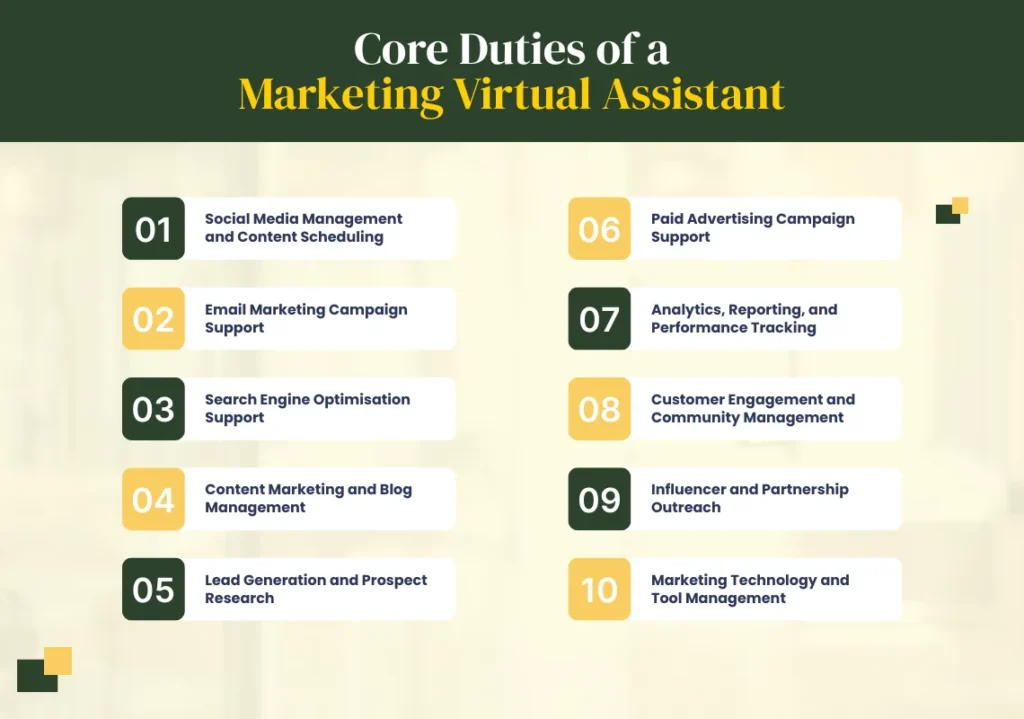
1. Social Media Management and Content Scheduling
One of the most common responsibilities of a marketing virtual assistant is managing social media platforms. Social media remains a dominant customer engagement channel in the UK, with Ofcom reporting that more than 57 million UK residents actively use social platforms.
Typical social media duties include:
- Creating content calendars aligned with brand campaigns
- Designing and posting social content across LinkedIn, Instagram, Facebook, and TikTok
- Scheduling posts using automation tools such as Hootsuite or Buffer
- Monitoring comments and direct messages
- Tracking engagement metrics and performance reports
Consistency plays a major role in social success. Businesses that post regularly see significantly higher engagement rates. Virtual assistants help maintain that consistency without increasing internal workload.
For example, a UK ecommerce brand may rely on a virtual assistant to schedule product promotions, respond to customer enquiries, and analyse monthly engagement performance. This helps maintain brand presence while freeing marketing managers to focus on campaign strategy.
2. Email Marketing Campaign Support
Email marketing continues to deliver one of the highest returns in digital marketing. According to the Data and Marketing Association UK, email marketing generates an average return of £35 to £42 for every £1 spent.
A marketing virtual assistant often manages:
- Building and maintaining subscriber lists
- Designing and scheduling newsletters
- Segmenting audiences for targeted campaigns
- Writing promotional and nurturing email content
- Tracking open rates, click through rates, and conversions
Virtual assistants also help maintain GDPR compliance by managing opt-in lists and ensuring proper data handling. For UK businesses, maintaining regulatory compliance is essential for avoiding penalties and protecting brand reputation.
3. Search Engine Optimisation Support
Search visibility remains one of the most valuable drivers of online traffic. BrightEdge research shows that organic search drives over 50 percent of website traffic globally.
Marketing virtual assistants contribute to SEO initiatives by handling tasks such as:
- Conducting keyword research
- Optimising website content and blog posts
- Updating meta descriptions and title tags
- Performing competitor analysis
- Monitoring search ranking performance
- Uploading and formatting blog content
SEO is a long term strategy that requires consistent effort. By delegating operational SEO tasks to a marketing virtual assistant, UK businesses can maintain steady content production and improve search visibility over time.
4. Content Marketing and Blog Management
Content marketing is one of the most effective ways to establish authority and build trust. HubSpot reports that companies publishing regular blog content generate 67 percent more leads compared to those that do not.
Virtual assistants support content marketing by:
- Researching blog topics aligned with customer search intent
- Formatting and publishing articles
- Creating basic graphics or sourcing visual content
- Managing content calendars
- Repurposing blog content into social media posts and email newsletters
For UK service based businesses, educational content builds credibility and supports lead generation. Virtual assistants help ensure publishing schedules remain consistent, which directly supports search rankings and audience engagement.
5. Lead Generation and Prospect Research
Lead generation remains a major challenge for many UK SMEs. A marketing virtual assistant supports lead generation by identifying and qualifying potential customers.
Common lead generation duties include:
- Researching prospects through LinkedIn and online directories
- Collecting contact information for outreach campaigns
- Managing CRM databases
- Preparing outreach templates
- Tracking lead engagement and follow up activities
A well organised lead pipeline increases sales team productivity. Virtual assistants ensure that sales teams spend more time closing deals rather than searching for potential clients.
6. Paid Advertising Campaign Support
Paid advertising requires constant monitoring and optimisation to achieve strong return on investment. Many UK businesses run campaigns across Google Ads, Facebook Ads, and LinkedIn Ads.
Marketing virtual assistants support paid advertising by:
- Setting up campaigns based on strategy guidelines
- Monitoring ad performance metrics
- Adjusting targeting parameters
- Preparing performance reports
- Managing budget tracking spreadsheets
WordStream research indicates that optimised paid advertising campaigns can increase conversion rates by up to 30 percent. By assisting with data analysis and campaign management, virtual assistants help maintain campaign efficiency.
7. Analytics, Reporting, and Performance Tracking
Data driven marketing decisions are essential for growth. Virtual assistants help gather, organise, and interpret marketing data.
Reporting responsibilities often include:
- Tracking website traffic using Google Analytics
- Monitoring social media performance dashboards
- Creating monthly marketing performance reports
- Identifying trends and campaign improvement opportunities
UK businesses rely heavily on data to justify marketing investment. Virtual assistants help transform raw marketing data into clear performance insights.
8. Customer Engagement and Community Management
Building customer relationships is essential for long term success. Virtual assistants help maintain brand communication through:
- Responding to social media comments
- Handling live chat enquiries
- Supporting customer feedback collection
- Managing online community groups
Customer experience directly impacts brand loyalty. Research from PwC UK shows that 73 percent of customers consider experience a key factor in purchasing decisions. Virtual assistants help ensure prompt and professional customer responses.
9. Influencer and Partnership Outreach
Influencer marketing is becoming increasingly popular across the UK. Businesses use partnerships to reach new audiences and improve brand credibility.
Marketing virtual assistants assist with:
- Researching relevant influencers
- Managing outreach communications
- Tracking collaboration performance
- Coordinating campaign deliverables
Micro influencer partnerships often deliver strong engagement rates, making them attractive for UK brands with limited marketing budgets.
10. Marketing Technology and Tool Management
Marketing relies heavily on digital platforms and automation tools. Virtual assistants help manage:
- CRM platforms
- Email marketing software
- Social scheduling tools
- Analytics dashboards
- Content management systems
Managing these tools requires attention to detail and regular updates. Virtual assistants ensure systems remain organised and efficient.
Why UK Businesses Are Choosing Virtual Marketing Support
The shift towards remote support teams is driven by cost efficiency and flexibility. Hiring full time marketing staff in the UK often involves significant recruitment expenses, salary commitments, and training costs.
Virtual support offers several advantages:
- Reduced operational costs
- Access to specialised global talent
- Flexible hiring options
- Faster onboarding
- Increased scalability
Many UK organisations are now comparing various virtual assistant companies to identify partners who can deliver reliable and skilled marketing support.
The Value of Structured Hiring and Skilled Talent
Quality remains the biggest concern when outsourcing marketing tasks. Businesses benefit most when virtual assistants are carefully vetted, trained, and matched with specific business needs.
For example, organisations working with Teambuild Consultancy often highlight the importance of structured hiring processes. Businesses frequently prefer partners who implement detailed screening steps to ensure assistants possess strong communication skills, technical marketing knowledge, and professional work ethics.
Access to highly skilled Filipino marketing professionals has become particularly popular among UK businesses because of their strong English proficiency, digital marketing expertise, and cost effective service structure. Many companies choose full time or part time support models depending on their operational requirements.
Cost Efficiency and Flexible Hiring Models
Budget flexibility is one of the strongest advantages of virtual marketing support. Traditional UK marketing hires often require long term salary commitments. Virtual assistant partnerships offer scalable pricing structures that support business growth at different stages.
Some service providers offer entry level support plans starting at affordable monthly pricing while part time dedicated support allows businesses to scale workload gradually. Flexible hiring ensures businesses only pay for the support they need, which is particularly valuable for growing startups and small enterprises.
How Marketing Virtual Assistants Support Business Growth
Marketing virtual assistants do more than complete routine tasks. They contribute to overall marketing strategy execution. By maintaining consistent marketing activity across multiple channels, virtual assistants help businesses:
- Improve brand visibility
- Increase lead generation
- Strengthen customer engagement
- Enhance campaign efficiency
- Reduce internal workload pressure
For UK businesses facing competitive digital markets, consistent execution often determines long term success.
Choosing the Right Marketing Virtual Assistant Partner
Selecting the right support partner requires evaluating several factors:
- Industry experience and marketing expertise
- Hiring and screening processes
- Communication and reporting transparency
- Pricing flexibility
- Scalability options
Businesses that conduct thorough research and partner with experienced service providers often achieve stronger long term results.
Final Thoughts
Marketing virtual assistants have evolved into strategic assets for UK businesses seeking scalable marketing support. From managing social media and email campaigns to supporting SEO and analytics reporting, virtual assistants provide operational strength that allows internal teams to focus on growth strategy.
As digital marketing becomes increasingly complex, businesses that leverage skilled virtual marketing support often gain a competitive advantage. Whether supporting startups or established enterprises, a marketing virtual assistant plays a vital role in ensuring consistent, data driven, and customer focused marketing execution.
For UK companies exploring expansion opportunities, understanding how to hire a virtual assistant for internet marketing and comparing trusted virtual assistant companies can be an important step toward building sustainable marketing operations.
Businesses that adopt remote marketing support early often position themselves for faster digital growth, stronger customer engagement, and improved marketing return on investment.