


Insurance claims are where trust is either built or broken. When a customer files a claim, they expect clarity, speed, and fairness. If the process drags on or feels confusing, frustration grows quickly. For insurance businesses in the United Kingdom, this makes claims processing one of the most important operational areas to get right.
Choosing the right insurance claims processing service provider is not just an operational decision. It is a business decision that affects customer satisfaction, regulatory compliance, and long-term profitability.
This guide is written for everyday decision-makers. You do not need a technical background to follow it. We explain everything in simple terms, remove unnecessary jargon, and focus on what truly matters when selecting a claims processing partner in the UK market.
Why claims processing deserves serious attention
Claims processing directly affects your reputation. Even the best policy means little if claims are handled poorly.
In the UK, insurers operate in a highly regulated environment. Customers are more informed, and complaints travel fast through reviews and social media. Delays, errors, or unclear communication can easily lead to complaints with the regulator or customer churn.
Industry research from McKinsey & Company has consistently shown that inefficient claims processes increase costs and reduce customer loyalty. Faster and clearer claims handling, on the other hand, improves retention and lowers operational expenses.
This is why many UK insurers now explore insurance process outsourcing as a way to stay competitive without inflating internal costs.
What does an insurance claims processing service provider do?
An insurance claims processing service provider supports insurers by handling part or all of the claims workflow. This can include:
- Claim intake and data entry
- Document checks and validation
- Policy verification
- Claim assessment support
- Customer communication and follow-ups
- Payment processing and reporting
Some providers manage the entire process. Others focus on specific tasks to support in-house teams.
The right setup depends on your volume, internal capacity, and business goals.
Common types of claims processing providers
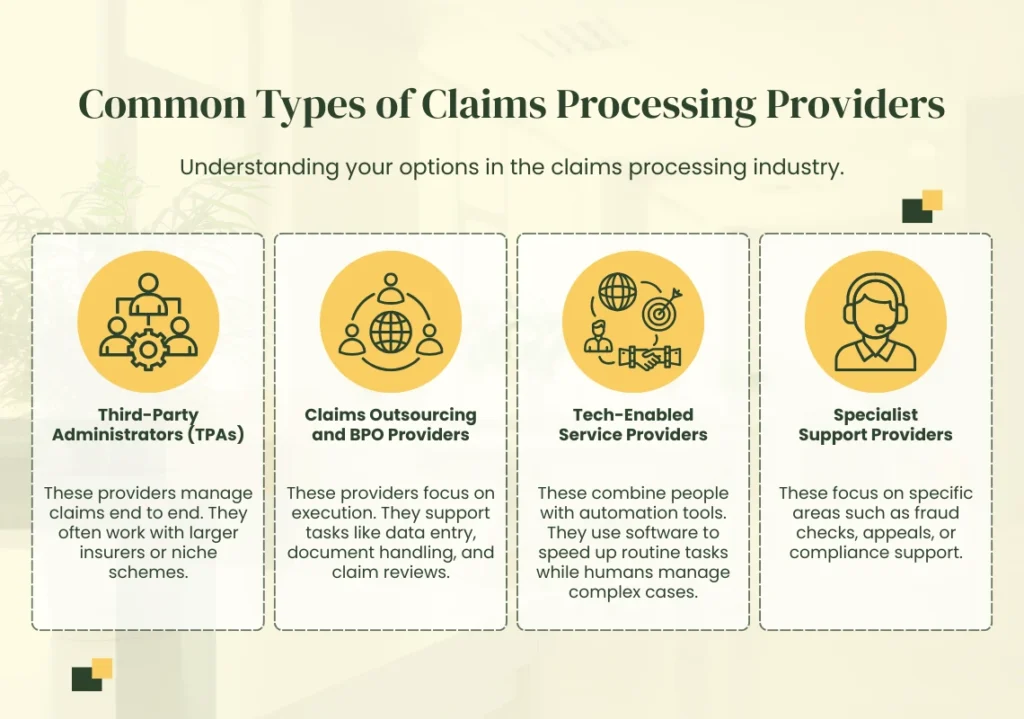
Before choosing a provider, it helps to understand the main options available in the market.
Third-party administrators
These providers manage claims end to end. They often work with larger insurers or niche schemes.
They suit businesses that want to fully outsource claims operations but still require strong oversight.
Claims outsourcing and BPO providers
These providers focus on execution. They support tasks like data entry, document handling, and claim reviews.
This option works well for insurers dealing with backlogs, seasonal spikes, or rapid growth.
Tech-enabled service providers
These combine people with automation tools. They use software to speed up routine tasks while humans manage complex cases.
This model suits insurers that want efficiency without losing human judgment.
Specialist support providers
These focus on specific areas such as fraud checks, appeals, or compliance support.
They are ideal when you need expertise without outsourcing everything.
When outsourcing claims processing makes sense
Outsourcing is not a shortcut. It works best when used intentionally.
It often makes sense if:
- Claim volumes fluctuate during the year
- Your internal team struggles with backlogs
- Hiring locally has become too expensive
- You need coverage outside UK working hours
- Administrative tasks distract skilled staff
It may not be the right choice if:
- Your processes are undocumented
- Internal accountability is unclear
- Data quality is poor
Fixing internal basics first always leads to better outsourcing results.
The UK regulatory angle you cannot ignore
In the UK, insurance claims handling falls under the oversight of the Financial Conduct Authority. The FCA expects insurers to treat customers fairly and handle claims promptly.
This means your claims partner must support:
- Clear timelines for claim acknowledgements
- Proper documentation and audit trails
- Consistent customer communication
- Transparent decision-making
If a provider cannot explain how they align with UK regulatory expectations in plain language, that is a warning sign.
Accuracy and fraud prevention matter more than speed alone
Speed is important, but accuracy protects your bottom line.
Insurance fraud costs the industry billions each year. Even small errors can add up when claim volumes grow. A reliable claims processing partner helps reduce these risks by applying consistent checks and clear workflows.
Look for providers that:
- Use structured review processes
- Apply quality checks before claim decisions
- Maintain clear records for audits
- Escalate unusual cases quickly
Cutting corners to save time often leads to higher costs later.
Security and data protection in simple terms
Claims data includes sensitive personal and financial information. In the UK, data protection is governed by GDPR and related laws.
A trustworthy provider should clearly explain:
- How they control system access
- How data is stored and protected
- What happens if a security incident occurs
- How long data is retained
If answers feel vague or overly technical, push for clarity. Good providers explain security in simple language because they understand its importance.
Key performance metrics to focus on
Do not get distracted by dozens of metrics. Focus on a few that truly matter.
These usually include:
- Average claim processing time
- Accuracy rate and error levels
- Rework or correction frequency
- Compliance with internal timelines
- Customer feedback or complaints
Ask how often reports are shared and how issues are resolved. Transparency builds trust.
Technology and automation without the hype
Automation can help, but it is not magic.
In claims processing, automation works best for:
- Sorting and indexing documents
- Extracting basic data
- Routing claims to the right team
Real-world examples show that automation can save thousands of work hours each month when applied correctly. However, automation must always support people, not replace judgment entirely.
A good provider uses automation quietly in the background and keeps humans involved where decisions matter.
Integration with your existing systems
A claims provider should fit into your workflow, not disrupt it.
They should clearly explain how they work with:
- Your claims management system
- Document storage tools
- Email and communication platforms
Avoid providers who promise easy integration but cannot explain how it works in practice.
Understanding pricing models clearly
Pricing should never feel confusing.
Common models include:
- Per-claim pricing
- Dedicated part-time or full-time staff
- Hybrid arrangements
What matters most is transparency. You should always know what is included and what costs extra.
How we approach claims support at our company
At our company, Teambuild Consultancy, we work with UK businesses that want reliable claims support without long-term hiring risks.
We provide skilled virtual assistants from the Philippines who support insurance operations with consistency and care. Our focus is not on selling complicated packages. We focus on practical support that fits into your existing setup.
Our pricing is slightly different, but it is ideal for people who need predictable costs and flexible support.
We offer:
- Part-time support at around £500 per month for 4 hours per day
- Full-time support at around £900 per month for 8 hours per day
This structure works well for insurers who want to scale gradually or test outsourcing without heavy commitments.
Why this model works well for UK insurers
UK insurers often face rising staffing costs and tight margins. Outsourcing routine claims tasks allows internal teams to focus on complex cases and customer relationships.
Working with dedicated virtual assistants can help:
- Reduce operational costs
- Improve turnaround times
- Maintain consistency in documentation
- Support internal teams without burnout
This approach also complements other back-office needs, such as when businesses look for virtual assistant help to reconcile QuickBooks alongside claims administration.
A simple step by step way to choose the right provider
To avoid mistakes, follow a clear process.
Start by:
- Defining which tasks you want to outsource
- Listing current challenges and volumes
- Setting clear expectations
Then:
- Shortlist providers with UK market experience
- Ask clear questions about compliance and security
- Request real examples of performance
- Test the relationship with a small pilot
Rushing this step often leads to costly changes later.
Red flags you should never ignore
Some warning signs are easy to spot.
Be cautious if a provider:
- Avoids sharing real metrics
- Overpromises unrealistic results
- Cannot explain compliance clearly
- Has no clear exit or transition plan
Trust your instincts. If communication feels difficult during sales, it will not improve later.
Final thoughts
Choosing an insurance claims processing service provider in the UK is about balance. You want speed, but not at the cost of accuracy. You want savings, but not at the cost of compliance or customer trust.
When done right, outsourcing becomes a strategic advantage. It helps insurers stay flexible, control costs, and improve customer experience.
Whether you explore insurance process outsourcing, add specialist support, or work with a dedicated virtual assistant team, the key is clarity. Ask simple questions. Expect simple answers.
At our company, Teambuild Consultancy, we believe good partnerships are built on transparency, reliability, and clear communication. When those elements are in place, claims processing stops being a problem and starts becoming a strength.