

Logistics operations in the UK are under constant pressure from rising fuel costs, tighter delivery windows, labour shortages, and increasing customer expectations for real-time visibility.
As a result, many logistics and supply chain leaders are rethinking how operational work is distributed, managed, and scaled. One solution that has quietly become central to modern logistics teams is the logistics virtual assistant.
This guide brings together everything UK businesses typically search for but rarely find in one place. It explains what a logistics virtual assistant is, how the role improves supply chain performance, how it compares with in-house logistics staff, and what realistic salary and cost benchmarks look like in the UK market.
It also explains why many UK companies now work with offshore talent from the Philippines, including through UK-based providers such as Teambuild Consultancy, without turning the discussion into a sales pitch.
What Is a Logistics Virtual Assistant?
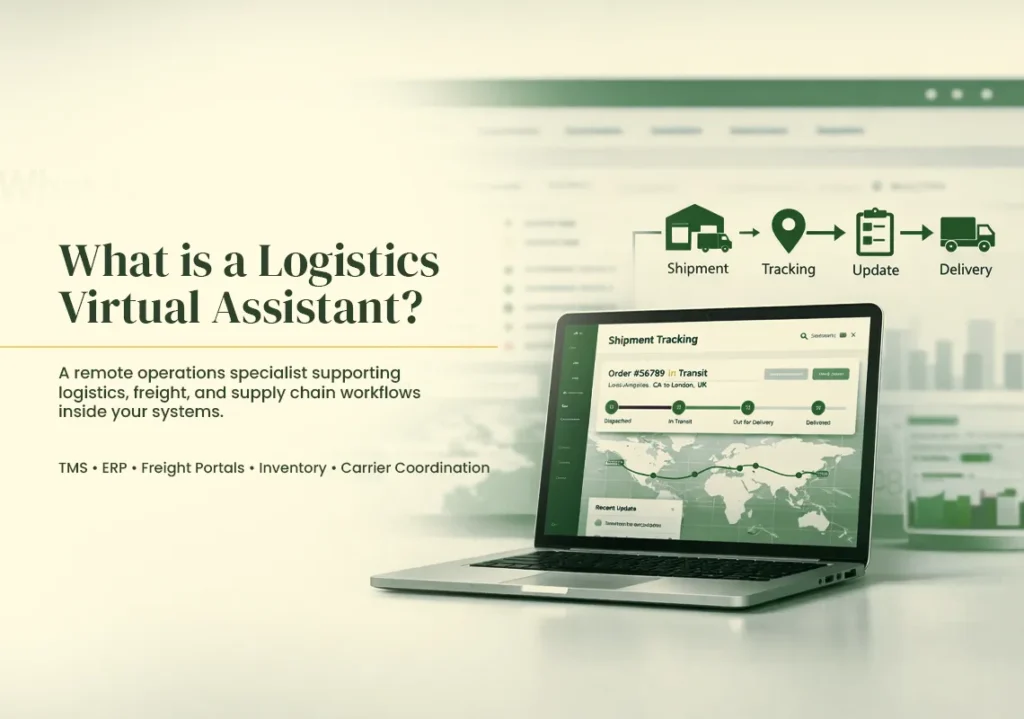
A logistics virtual assistant is a remote professional who supports logistics, transport, freight, and supply chain operations through digital systems rather than physical presence.
Unlike a general administrative assistant, a logistics virtual assistant specialises in workflows such as shipment tracking, order processing, carrier coordination, inventory updates, and logistics documentation.
The role exists to reduce operational friction, improve data accuracy, and free up logistics managers to focus on strategy rather than routine execution.
In UK logistics environments, virtual assistants often work directly inside systems like TMS platforms, ERP tools, freight portals, and supplier dashboards.
They operate as part of the internal team but work remotely, typically across time zones that allow extended coverage beyond standard UK business hours.
This makes the logistics virtual assistant particularly valuable in industries where delays and exceptions occur outside the traditional 9-to-5 window.
Many businesses initially confuse this role with a Personal Virtual Assistant, but the difference lies in specialisation. A Personal Virtual Assistant focuses on calendar management, inbox handling, and executive support, while a logistics virtual assistant is process-driven and embedded in operational workflows.
Both roles add value, but logistics support requires industry context, system familiarity, and process discipline.
Why the Logistics Virtual Assistant Role Is Growing in the UK
The UK logistics sector has faced structural challenges since Brexit, including customs complexity, driver shortages, and higher compliance requirements. At the same time, e-commerce growth has increased shipment volumes while compressing delivery expectations. These pressures have created a mismatch between available local talent and the volume of operational work that must be completed daily.
Hiring locally for logistics coordination roles in the UK often means competing with large 3PLs and carriers on salary.
Small and mid-sized businesses, particularly importers, distributors, and e-commerce brands, struggle to justify £28,000–£40,000 annual salaries for admin-heavy logistics roles. This gap has accelerated interest in remote logistics support models.
Virtual assistants allow UK companies to scale operational capacity without increasing office overheads or long-term employment risk. They also allow businesses to stabilise processes before investing in automation or additional software.
For many teams, a logistics virtual assistant becomes the connective tissue between systems, suppliers, and internal stakeholders.
Core Responsibilities of a Logistics Virtual Assistant
A logistics virtual assistant typically handles a defined set of repeatable, process-driven tasks that sit at the heart of supply chain execution. These tasks vary by business model but tend to follow common patterns across UK logistics operations.
Shipment tracking and status updates form one of the most common responsibilities. The assistant monitors carrier portals, freight forwarder updates, and tracking tools to ensure milestones are met and delays are flagged early. This proactive monitoring reduces reactive firefighting by logistics managers.
Order processing and data entry are also central to the role. Virtual assistants input sales orders into ERP or TMS systems, validate shipping details, and ensure documentation accuracy. Accurate data at this stage prevents downstream issues such as mis-shipments, invoicing errors, and customer complaints.
Carrier and supplier coordination is another key function. A logistics virtual assistant communicates with freight forwarders, couriers, warehouses, and customs agents to confirm bookings, resolve discrepancies, and follow up on outstanding actions. This coordination role is particularly valuable for UK importers dealing with international suppliers.
Inventory updates and reporting often sit within the assistant’s remit. They reconcile stock movements, update inventory levels, and generate daily or weekly logistics reports for internal teams. These reports improve decision-making by providing visibility without consuming management time.
Documentation management is critical in UK logistics environments. Virtual assistants prepare and organise invoices, packing lists, bills of lading, proof of delivery documents, and customs paperwork. This ensures compliance while reducing the administrative burden on senior staff.
How a Logistics Virtual Assistant Improves Supply Chain Management
The real value of a logistics virtual assistant lies not in task completion, but in process improvement and operational stability. When implemented correctly, the role directly impacts cost control, service levels, and risk management.
Improved visibility is one of the most immediate benefits. By continuously monitoring shipments and inventory, the assistant creates a single source of operational truth. This visibility allows UK businesses to respond faster to disruptions such as port congestion or carrier delays.
Cost control improves through error reduction. Manual logistics errors are expensive, often resulting in re-delivery fees, storage charges, or lost inventory. A dedicated virtual assistant focused on accuracy significantly reduces these hidden costs.
Supply chain resilience also improves. When operational knowledge is documented and managed by a virtual assistant, processes become less dependent on individual team members. This reduces risk when staff are absent or when demand spikes unexpectedly.
Scalability is another major advantage. UK businesses can increase or reduce assistant hours in line with seasonal demand without restructuring internal teams. This flexibility is particularly valuable in retail, FMCG, and e-commerce logistics.
Many companies also find that virtual assistants act as informal process auditors. Because they follow documented workflows closely, they often identify inefficiencies or gaps that internal teams overlook. This leads to gradual, continuous improvement rather than disruptive change.
The Philippines as a Hub for Logistics Virtual Assistants
The Philippines has become one of the world’s most reliable sources of logistics and operations-focused virtual assistants.
This reputation is built on strong English proficiency, cultural alignment with Western businesses, and a large workforce experienced in BPO and logistics support roles.
Many Filipino virtual assistants have prior experience working with freight forwarders, shipping lines, e-commerce platforms, and ERP systems. This background reduces onboarding time and increases productivity from the outset. Time zone overlap with the UK also allows for same-day collaboration.
Teambuild Consultancy, as a UK-based virtual assistant company, sources logistics virtual assistants from the Philippines while managing hiring, compliance, and support locally. This structure allows UK businesses to access global talent without navigating international employment complexity. The focus on the top 1% of Filipino talent ensures consistent quality without overstating the claim.
Rather than replacing UK staff, these assistants typically complement existing teams. They absorb high-volume operational work so UK-based managers and coordinators can focus on supplier relationships, optimisation, and strategy.
Logistics Virtual Assistant Salary and Cost Benchmarks in the UK
Understanding cost is a major search intent that competitors often under-address or oversimplify. UK businesses want clarity on both in-house salaries and virtual assistant pricing.
In the UK, an in-house logistics administrator typically earns between £24,000 and £32,000 per year, excluding employer NI, pension contributions, office space, and training costs. More experienced logistics coordinators can earn £35,000 or more, particularly in London and the South East. These costs can be prohibitive for smaller teams.
By contrast, logistics virtual assistant costs are typically structured as monthly service fees rather than salaries.
Through Teambuild Consultancy, UK companies can access part-time logistics virtual assistant support for approximately £500 per month for 4 hours per day. Full-time support is available at approximately £900 per month for 8 hours per day.
These figures include recruitment, payroll, and ongoing support, which simplifies budgeting. The cost difference allows UK businesses to reallocate savings into technology, carrier negotiations, or customer experience improvements. Importantly, lower cost does not imply lower capability when sourcing is done correctly.
When a Logistics Virtual Assistant Makes the Most Sense
Not every logistics function should be outsourced, and clarity here builds trust. A logistics virtual assistant is most effective when tasks are repeatable, system-based, and process-driven.
Businesses with growing shipment volumes but stable workflows benefit significantly. Companies managing multiple carriers, SKUs, or international suppliers also see strong returns. E-commerce brands handling daily order flows are particularly well suited to this model.
The role is less suitable for positions requiring physical warehouse presence or complex, real-time negotiation. However, even in these environments, a virtual assistant can support documentation, reporting, and coordination work.
Many UK businesses start with a single logistics virtual assistant and expand gradually. This phased approach reduces risk and allows processes to mature organically.
Logistics Virtual Assistants vs Automation Tools
Automation software is often positioned as an alternative to human support, but the reality is more nuanced. Most UK logistics systems still require human oversight due to exceptions, data inconsistency, and supplier variability.
A logistics virtual assistant complements automation rather than competing with it. They manage exceptions, validate outputs, and ensure systems are used correctly. This hybrid approach delivers better outcomes than software alone.
In many cases, businesses use virtual assistants to stabilise processes before automating them. This sequence reduces failed implementations and wasted investment.
Final Thoughts: A Practical Model for UK Logistics Teams
The logistics virtual assistant model reflects a broader shift in how UK businesses think about work allocation.
Rather than tying every operational task to local headcount, companies are building distributed teams supported by clear processes and accountability.
When sourced responsibly, logistics virtual assistants from the Philippines provide expertise, consistency, and flexibility.
UK-based providers like Teambuild Consultancy add an additional layer of governance and alignment without inflating costs. The result is a sustainable operating model rather than a short-term cost-cutting tactic.
For logistics leaders, the key question is no longer whether virtual assistants belong in supply chains. The real question is how effectively they are integrated into systems, processes, and teams.