

For many UK business owners, QuickBooks reconciliation is one of those tasks that never feels urgent until it suddenly becomes a problem.
You know it matters.
You know it affects cash flow, VAT, and reporting.
But it also eats up hours every month.
At our company, Teambuild Consultancy, we speak with UK founders, finance managers, and accounting professionals every week who ask the same question:
Can a virtual assistant reconcile QuickBooks accounts remotely and still do it properly?
The answer is yes.
But only when the work is structured, controlled, and reviewed correctly.
This article explains how remote QuickBooks reconciliation works in real life, what a virtual assistant can safely handle, how UK businesses stay in control, and when outsourcing makes sense.
No technical language. No sales hype. Just practical guidance.
Why this question matters more for UK businesses
UK businesses face increasing pressure to keep clean, accurate financial records.
Making Tax Digital rules continue to push companies toward better digital record keeping. Cash flow volatility makes real time financial visibility more important than ever. Many founders and directors simply do not have the time to reconcile accounts themselves every month.
Industry data supports this challenge. Studies consistently show that small business owners spend several hours per week on manual finance tasks. Reconciliation often takes the longest, especially for ecommerce businesses, service companies with multiple payment methods, and firms with several bank accounts or credit cards.
That is why more UK businesses now look for support from a quickbooks virtual assistant rather than trying to do everything in house.
What remote QuickBooks reconciliation actually means
Remote reconciliation does not mean giving someone full access to your bank.
It means giving a trained virtual assistant controlled access to QuickBooks Online so they can match transactions against your bank or card statements.
Each month, a virtual assistant can:
- Match income and expenses to statements
- Identify missing or duplicate transactions
- Flag unusual items
- Prepare reconciliation reports
- Highlight issues that need clarification
You remain in control of approvals, payments, and final decisions.
This model works particularly well when businesses already use QuickBooks Online and bank feeds or monthly statements.
What a virtual assistant can do safely in QuickBooks
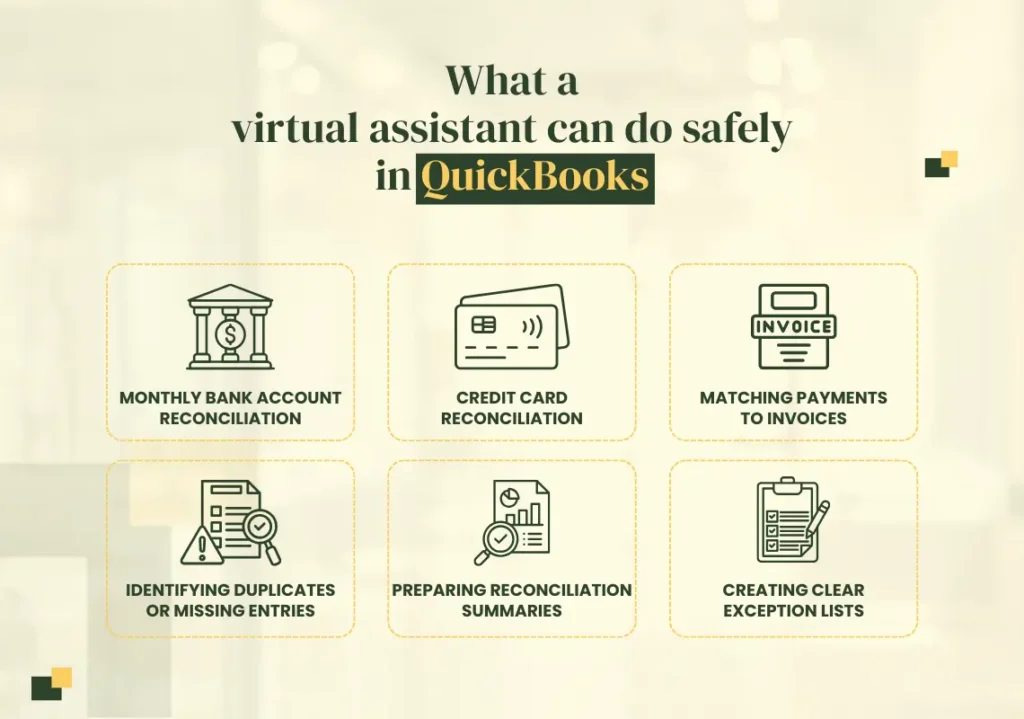
A properly trained accounting virtual assistant can handle structured, repeatable tasks with confidence.
These typically include:
- Monthly bank account reconciliation
- Credit card reconciliation
- Matching payments to invoices
- Identifying duplicates or missing entries
- Preparing reconciliation summaries
- Creating clear exception lists
These tasks follow defined rules. They do not require judgement calls about tax treatment or accounting policy.
At our company, Teambuild Consultancy, we ensure our accounting virtual assistants understand where their responsibility ends and when to escalate.
That boundary is essential for quality and risk control.
What should not be handled by a virtual assistant
Some tasks should always remain with a qualified bookkeeper or accountant.
These include:
- Posting journal entries
- Making adjustments to force balances to match
- Deciding VAT treatment
- Correcting errors from prior filed returns
- Making accounting policy decisions
A reliable virtual assistant will never guess or push a reconciliation through just to make it balance.
When something does not match, the correct action is to stop, document the issue, and escalate it.
How remote QuickBooks reconciliation works step by step
To remove ambiguity, let us walk through the actual monthly process.
Step one. You provide the essentials
Each month, you or your finance lead provides:
- Bank and credit card statements in PDF format
- Access to QuickBooks Online
- A list of accounts to reconcile
- Location of supporting documents if required
This setup only happens once. After that, it becomes routine.
Step two. Reconciliation begins account by account
The virtual assistant works through each account separately.
They always start with the oldest unreconciled month and move forward in order. This prevents errors from carrying over.
For each account, they:
- Compare QuickBooks transactions to the statement
- Match each item
- Investigate any differences
- Leave notes where something is unclear
Step three. Exceptions are clearly flagged
If something does not reconcile, the assistant does not hide it.
Instead, they create an exception list explaining:
- What does not match
- Why it might be happening
- What information is needed
This keeps everything transparent.
Step four. You receive a monthly reconciliation pack
At the end of the process, you receive clear outputs rather than vague assurances.
What you should receive every month
This is where many service providers fall short.
Proper reconciliation always produces evidence.
Each month, you should receive:
- Reconciliation reports for each account
- A short exception list
- Notes on unusual or high risk transactions
- Confirmation that balances match statements
If you do not receive these items, you are relying on trust alone. That is not a strong control system.
How UK business owners stay in control
Remote support does not mean giving up oversight.
In fact, many UK owners find they gain more control because everything becomes documented and consistent.
Here is how that control works in practice.
Limited access
You give your virtual assistant access only to what they need inside QuickBooks. They do not require full admin rights in most cases.
Audit visibility
QuickBooks keeps a record of changes made to transactions. You can review this activity quickly and see exactly what was done.
Simple monthly review
Most of our clients spend five to ten minutes each month reviewing reconciliation reports and exception notes. That is usually enough to maintain confidence and control.
What done properly really looks like
A reconciliation is complete only when:
- Statement balances match QuickBooks
- No unexplained differences remain
- Exceptions are clearly documented
- Reports are saved and shared
Anything else is unfinished work.
At Teambuild Consultancy, we train our accounting virtual assistants to treat reconciliation as a process with a clear finish line, not a checkbox exercise.
Cost considerations for UK businesses
Cost often drives the decision to outsource reconciliation.
Local hiring brings benefits, but it also brings higher overheads, limited flexibility, and long term commitments.
Many UK businesses now explore offshore support for this reason.
Our pricing is slightly different, but it is ideal for people who need predictable monthly costs rather than hourly uncertainty.
At our company, Teambuild Consultancy, we offer:
- Part time support at approximately £500 per month
- Full time support at approximately £900 per month
Part time works well for businesses with steady monthly volumes. Full time suits companies with multiple accounts, ecommerce complexity, or accounting firms supporting many clients.
Compared to local hourly rates, this structure offers consistency and scalability.
Why this matters for compliance and reporting
Clean reconciliations do more than tidy your books.
They support:
- Accurate VAT submissions
- Better cash flow visibility
- Faster month end close
- Easier year end preparation
- Fewer surprises during accountant reviews
As Making Tax Digital requirements expand, accurate digital records will only become more important. Businesses that treat reconciliation as a monthly habit rather than a yearly scramble are better positioned to adapt.
A practical example from everyday business
Consider a UK ecommerce company using Shopify, Stripe, PayPal, and a business bank account.
Before outsourcing:
- Two months behind on reconciliations
- Confusing balances
- No confidence in cash position
After assigning a virtual assistant:
- Accounts reconciled monthly
- Exceptions clearly logged
- Owner reviews reports quickly
- Accountant receives clean data at year end
The difference is not just time saved. It is peace of mind.
Who benefits most from this approach
Remote QuickBooks reconciliation works especially well for:
- UK small business owners
- Startup founders and scale up teams
- Finance managers with limited internal support
- Accounting firms managing multiple clients
- Bookkeeping practices needing consistent back office help
Many accounting firms now choose to hire a virtual assistant experienced with digital accounting tools to support reconciliations while senior staff focus on advisory work.
Common concerns and honest answers
Do I need to share bank logins?
No. You should never share bank login details.
What if something does not balance?
The virtual assistant documents the issue and escalates it.
Can a VA handle catch up work?
Yes, as long as statements are available and the process follows a clear order.
Does this replace my accountant?
No. It supports your accountant by keeping records clean and current.
How we approach this at Teambuild Consultancy
We do not treat reconciliation as a generic admin task.
At our company, Teambuild Consultancy, we match clients with virtual assistants who understand accounting workflows, digital tools, and the importance of controls.
We focus on clarity, consistency, and communication.
Our goal is not to replace your financial judgement. It is to remove the manual burden so you can focus on running and growing your business.
Final thoughts
Yes, a virtual assistant can reconcile QuickBooks accounts remotely.
When done properly, it saves time, reduces stress, and improves financial clarity.
The key is structure. Clear scope. Clear outputs. Clear review.
If you approach it thoughtfully, remote reconciliation becomes one of the most practical ways to improve your finance operations without increasing overhead.
If you want to explore this model, start by asking one simple question.
Do I want to spend my time matching transactions, or making decisions that move my business forward?
The answer usually makes the choice clear.