

Being a small business owner, startup founder, or busy executive often means juggling countless tasks with limited time. Studies have shown that small business owners spend an average of 16 hours per week on administrative tasks, two full workdays lost to admin. In fact, a Forbes survey mentioned that entrepreneurs devote 36% of their work week to busywork like invoicing, data entry, and other routine tasks.
This is time not spent on strategic growth, innovation, or family. It’s no surprise that many turn to outsourced personal assistants, also known as virtual personal assistants. But is it really worth it to outsource your personal assistant needs? Let’s explore the benefits, costs, and considerations to find out.
What Is an Outsourced Personal Assistant?
An outsourced personal assistant (or virtual personal assistant) is a highly skilled professional who provides administrative, technical, or creative support remotely from outside your office.
Instead of being an on-site employee, a virtual assistant (VA) works online via email, phone, and cloud-based tools to help manage your workflow.
What can a virtual personal assistant do?
Quite a lot. Typically, VAs handle administrative tasks such as managing your calendar and inbox, scheduling meetings, booking travel, data entry, and preparing documents.
They can also assist with personal tasks (like making appointments or event planning) and act as a point of contact to coordinate with others on your behalf.
Beyond basics, many outsourced assistants offer specialised skills. For example, you can find VAs experienced in bookkeeping, social media management, customer service, content creation, research, and more.
Benefits of Hiring a Virtual Personal Assistant
Why do entrepreneurs and executives turn to virtual assistants? The benefits go far beyond just saving money (though that’s a big one!). Here are some of the key advantages of outsourcing a personal assistant, with data and examples to illustrate their impact:
Significant Cost Savings
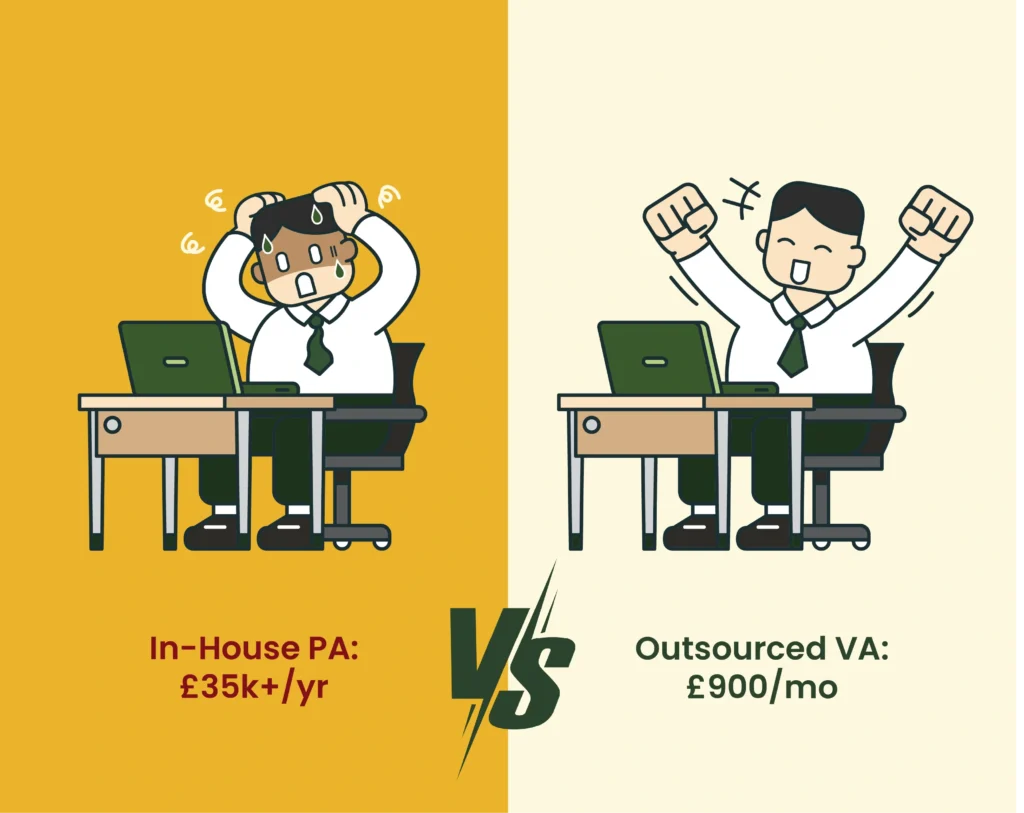
Hiring a full-time, in-house personal assistant in a country like the UK or the US can be expensive once you factor in salary, benefits, taxes, and office overhead.
In contrast, virtual assistants (especially those offshore) come at a much lower hourly rate with none of the usual employee-related costs. You pay only for the hours or tasks you need, without funding lunch breaks, idle time, office space, or equipment.
Even highly experienced US/UK-based VAs at higher rates tend to cost far less overall than an equivalent employee once overhead is considered.
Moreover, outsourcing to countries with lower labour costs can yield huge savings. Businesses can save around 70-75% on labour costs by hiring a virtual assistant from the Philippines versus a local hire. (We’ll dive deeper into the cost comparison in the next section.) These savings make a big difference for a small business budget.
Increased Productivity & Focus
Offloading routine work to a VA lets you reclaim hours in your day. Instead of bogging down a CEO or founder with scheduling, emails, or data entry, your assistant can handle those tasks, freeing you to focus on high-value activities (strategy, sales, product development, etc.).
Research backs this up: companies see a 20-40% boost in overall productivity when they delegate administrative and low-value tasks to assistants.
In one study, Harvard Business Review noted that simply ditching or delegating low-value work can increase productivity by around 20%, and other industry surveys report businesses using VAs experience roughly a 40% productivity increase after offloading admin work.
The bottom line is that a good virtual assistant enables you and your core team to complete more in less time. You spend time on what drives growth, while your VPA efficiently handles the rest.
Flexibility and Scalability
One huge advantage of outsourcing is flexibility. Need help just 20 hours a week? Or need to ramp up to full-time support during a busy season? With virtual assistants you can scale hours up or down easily to match your workload. This is ideal for startups and small businesses whose support needs might fluctuate.
Flexibility also extends to scheduling, as many VAs are open to working outside a traditional 9-5 to align with your needs. This means you can get coverage outside your own business hours. Thanks to global time zones, some companies even achieve round-the-clock service by leveraging overseas assistants.
Access to Global Talent & Specialised Skills
When hiring locally, you’re limited to the talent in your area; with a virtual assistant, you have access to a global talent pool. This means you can find exactly the right skill set for the task.
Need someone who’s fluent in Spanish, proficient in Photoshop, or experienced in bookkeeping for your industry? There’s likely a VA out there who checks all the boxes.
Many Filipino VAs, for example, have college degrees and diverse skill sets. You can find VAs with expertise in marketing, graphic design, IT support, content writing, customer service, and more. You effectively get to “hire” top talent worldwide without geographic constraints.
Moreover, outsourcing agencies often rigidly pre-vet their assistants. At our company, we use a six-step hiring process that filters for the top 1% of global talent, so clients get a top-notch assistant from the start.
Tapping into global talent also brings fresh perspectives and often multilingual capabilities, which can be a boon if you operate in international markets. In sum, outsourcing opens the door to skills and experience that might be scarce or cost-prohibitive to find locally.
Reduced Overhead & Administrative Burden
Every new in-house employee comes with hidden costs and workloads, such as providing office space, computer equipment, HR management, benefits administration, and handling payroll taxes and insurance.
An outsourced assistant spares you from almost all of that.
No office space or equipment is needed (they typically have their own setup). You don’t pay employer NI contributions, pension, or health insurance; those aren’t your responsibility for a contractor. This lean model means less red tape and lower overheads for your business.
Also, if you work through a VA agency like us, they often handle the time-consuming aspects of recruiting, vetting, and even replacing a VA if it’s not a good fit. That saves your management team’s time.
Takeaway: These benefits make a clear case for many small business owners and executives. It’s not surprising that in a survey, the top reasons people hire virtual assistants are to save time (67% of respondents) and to delegate tasks (53%), followed closely by increasing productivity and reducing stress.
Saving money was also cited (by ~16%), but interestingly, the time and efficiency gains often drive the decision. A well-chosen virtual personal assistant can act as a force multiplier for you, efficiently handling the essential routine work in the background. At the same time, you concentrate on the big picture.
Outsourced Virtual Assistant vs In-House: Cost and Productivity Comparison
| Criteria | Outsourced (Filipino Virtual Personal Assistant) | In-House PA (UK employee) |
| Typical total cost | £900/month full-time | £35k–£75k/yr salary (London), avg ≈ £45k/yr³ + 20–30% on costs (NI, pension, holidays, office)⁴ |
| What you pay for | “Hours you pay” = productive time/deliverables only | Fixed salary regardless of daily workload |
| Overheads/benefits | None for you (contractor/agency handles) | Employer NI, pension, holidays, sick pay, space/equipment |
| Time to hire / onboarding | 5-7 Days | Weeks–months (recruit, interviews, notice periods) |
| Flexibility & scalability | Scale hours up/down quickly; add a dedicated assistant for projects | Fixed 35–40 hrs/week; scaling needs new headcount |
| Productivity leverage | Frees leadership to delegate admin tasks (inbox, email management, calendar management, data entry, bookkeeping); often 24/7 handoffs | Frees time during office hours; limited by on-site schedules |
| Coverage / time zone | Can align to UK hours or offset for overnight progress; great for customer support SLAs | UK business hours unless you hire shifts |
| Skills & specialisation | Access global talent; match specific needs and skills & experience (social media, bookkeeping, admin, research, customer service support) | Broader generalist; deep company knowledge over time |
| Management & HR load | Low: agency handles hiring process, replacement/backup | High: HR admin, line-management, performance reviews |
| Onboarding & SOPs | Lightweight; start with clear SOPs, start delegating gradually | Heavier onboarding; internal policies, compliance training |
| Data security & compliance | NDAs, role-based access; ensure GDPR-compliant processes with vendor | Internal controls; easier physical oversight |
| Best fit | Founders needing to save time, streamline ops, free up your time, cover important tasks, or handle business or personal items (travel arrangements, scheduling appointments, social media accounts) seamlessly | Teams needing a permanent on-site executive assistant/in-house assistant embedded in daily office rhythms |
| ROI angle | Lower cash outlay; services allow managers to focus on what matters, grow your business, and help you grow your business | Higher control/availability; stronger embedded culture |
Why the Philippines Is the Top Choice for Virtual Assistants?
If you’re outsourcing a personal assistant, the Philippines is one of the best places to look. Here’s why so many businesses around the world choose Filipino virtual assistants and why Teambuild Consultancy hires exclusively from the Philippines.
1. Cost-Effective Talent
Hiring in the Philippines gives you excellent value for money. Wages and living costs are much lower than in the West, so UK and US businesses can save up to 70% on salaries. A skilled full-time VA might earn £500-1000/month, making it affordable for small businesses to get high-quality support.
2. Excellent English Skills
English is an official language in the Philippines, taught in schools and used in the media. Most Filipinos speak fluent English and understand Western culture, idioms, and business etiquette, making communication easy and clear.
3. Strong Work Ethic and Reliability
Filipino workers are known for being hardworking, polite, and loyal. They value long-term relationships and often go the extra mile to help clients succeed. This reliability leads to strong performance and low turnover.
4. Educated and Skilled Workforce
The Philippines produces many college graduates in business, IT, and communications each year. Most VAs are tech-savvy, quick learners, and experienced in customer service, marketing, or admin work. The BPO industry has helped develop a wide range of skills across the workforce.
5. Convenient time Zone
The Philippines (GMT+8) allows for flexible coverage. Many VAs are open to night shifts to match UK or US hours. You can hand off tasks at the end of your day and have them completed by morning. Your business keeps running while you sleep.
6. Established Outsourcing Industry
With decades of outsourcing experience, the Philippines has a strong infrastructure, government support, and a deep pool of trained professionals. If your first hire doesn’t fit, replacements are easy to find.
Final Answer
For the vast majority of small businesses and startups, outsourcing a personal assistant is worth it. It’s a strategic move that maximises efficiency and growth while controlling costs. As we’ve seen, companies routinely report cost savings of 50–75% and productivity gains of 20–40% or more when integrating virtual assistants into their operations. Those are hard numbers to ignore.